
Reviewed · COMMUNIST HISTORY TOURS
Communist Budapest Private Walking Tour
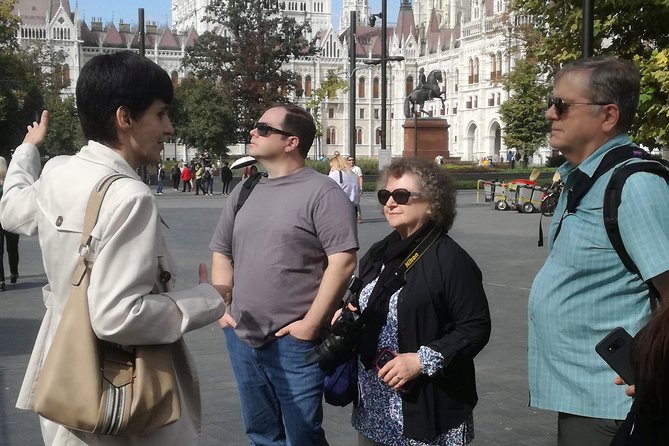
Budapest’s communist past is hiding in plain sight. This three-hour private walk connects Parliament, Cold War monuments, socialist statues, a 1970s housing estate, and the former secret police headquarters. I like the historian-led storytelling and the way the route links major political events with ordinary city streets. I also like the private format, since guides can adjust the conversation to your interests.
The main consideration is price. At $393.17 per group, it makes the most sense for a small party that will share the cost. Public transport tickets are not included, and the published group limit appears in several forms, up to 6, 8, or 10 people, so I would confirm the exact maximum before booking.
In This Review
- Key points to know before booking
- Why communist Budapest deserves three hours
- Starting near Frankel Leó út and reaching Parliament
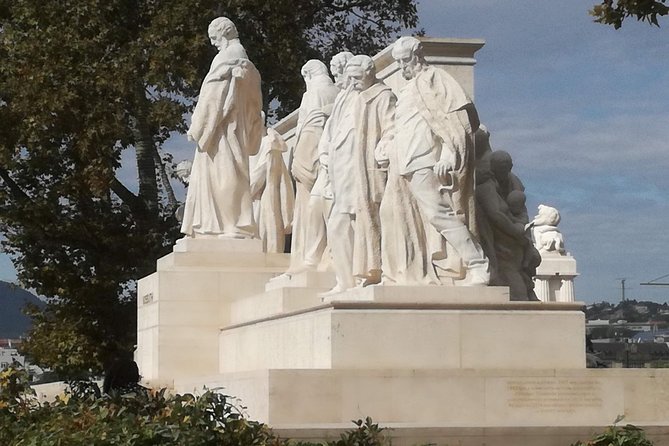
- Kossuth Square and the memory of 1956
- Liberty Square, the Cold War, and competing symbols
- Puskás Ferenc Stadium and socialist propaganda
- Bem József Square, where revolt found its voice
- The House of Terror as a powerful endpoint
- What the private format changes
- Is $393.17 a fair price?
- Who will get the most from this walk?
- Should you book the Communist Budapest Private Walking Tour?
- FAQ
- How long is the Communist Budapest Private Walking Tour?
- Is hotel pickup available?
- Are public transport tickets included?
- Does the tour enter the House of Terror Museum?
- Is the tour offered in English?
- Can I cancel for a full refund?
Key points to know before booking
- The 1956 uprising is central: Bem József Square and Kossuth Square help explain how protest spread through Budapest.
- You see communism beyond grand monuments: A 1970s housing estate and an old coffeehouse add everyday detail to the political story.
- The route uses Budapest transit: Your guide can lead you by metro, tram, or on foot, but tickets are extra unless you already have a pass.
- The House of Terror is an exterior stop: The museum visit is not included, though the tour ends outside its former secret service headquarters.
- The private setup adds flexibility: Morning and afternoon departures are offered, and guides can shape the discussion around your interests.
- Guide quality is a major strength: Andras is praised for adapting the tour, while Kata is noted for clear explanations, broad perspective, humor, and grace.
Why communist Budapest deserves three hours
Budapest’s communist period lasted from 1949 until 1989, but it was not one long, simple chapter. The city saw Soviet control, the violent suppression of the 1956 revolution, cautious economic reforms, daily shortages, state propaganda, and finally the quiet collapse of one-party rule.
That mixture is what makes this tour useful. You are not simply shown a statue and told when it was built. You are asked to connect buildings, public squares, transport routes, sports grounds, and housing blocks with the political system that shaped them.
I especially appreciate the focus on goulash communism, Hungary’s nickname for the somewhat more relaxed consumer culture that developed under János Kádár. Life was still controlled and often difficult, but the system allowed more private enterprise and personal comfort than many other Soviet-aligned states. The result was a strange compromise: political silence in exchange for a degree of everyday stability.
A local historian can explain those shades better than a guide who only recites dates. That matters here because the subject includes both public events and private life. You will hear about May Day parades and Soviet monuments, but also about what people could buy, what they could not say, and how the city learned to live with official propaganda.
More communist-era history walks:
- Budapest: Communist History Tour with House of Terror Option
★ 4.8 · 182 reviews - Communism in Hungary with a Historian
★ 5.0 · 70 reviews - Budapest: 3-Hour Walking Tour About Communism (Small Group)
★ 4.7 · 70 reviews
Starting near Frankel Leó út and reaching Parliament
The default meeting point is at Frankel Leó út 2-4 in Budapest’s District II. Pickup is also offered from a central hotel or flat, with the guide arranging the starting point after booking. If you do not provide an address or prefer not to use pickup, you should arrive at the default meeting point 15 minutes before departure.
From there, your guide leads you by metro, tram, or on foot, depending on the route and where you are staying. This is a practical feature, not just a minor convenience. Budapest’s communist story is spread across several districts, and public transport lets you cover more ground than a purely central walking tour.
The guide can help you buy the needed metro or tram tickets if you do not already hold a transport pass. Build a little flexibility into your plans, since the tour is advertised at approximately three hours and the transit connections are part of the experience.
The private format should also make the pace more comfortable. You can ask questions as they occur instead of saving them for a crowded group’s designated pause. Andras, one of the guides, is praised for adjusting a four-hour private tour to suit his group’s interests. That is the sort of flexibility I would want for a subject as broad as Hungarian communism.
Kossuth Square and the memory of 1956
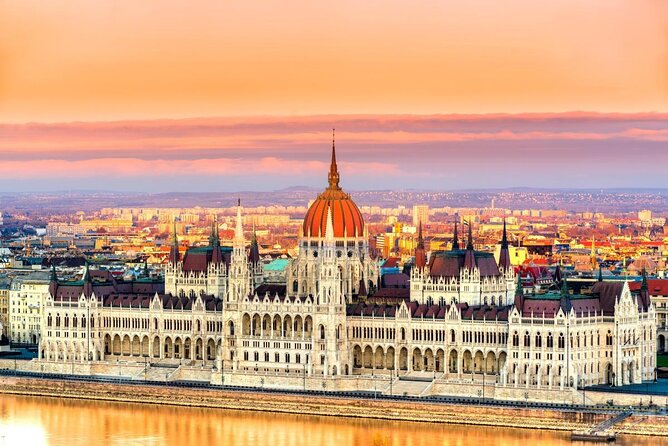
The tour begins around the Hungarian Parliament Building at Kossuth Square. Parliament itself is one of Budapest’s best-known sights, but here the focus shifts from architecture to the monuments and memories connected with the 1956 revolution.
The uprising began as a protest against Soviet control and Hungary’s hard-line communist government. It grew rapidly, then was crushed by Soviet military force. Kossuth Square is therefore not just a grand civic space. It is a place where the struggle over public power, national independence, and political memory becomes visible.
Your guide discusses monuments connected with the revolution before moving toward Liberty Square. This part of the tour is valuable because it gives you a political framework early. Later sights, including the Soviet monument and the House of Terror, make more sense once you understand why 1956 remains such a charged subject in Hungary.
The listed stop lasts about 25 minutes and has no admission charge. You should expect the guide to do most of the explaining outdoors. Comfortable shoes and protection from sun or rain will help, since the experience is an actual walking tour rather than a museum program.
Liberty Square, the Cold War, and competing symbols
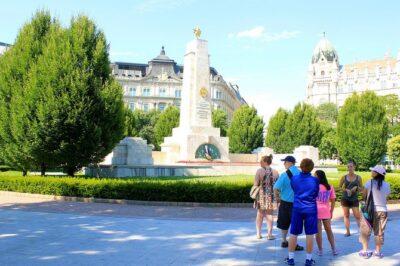
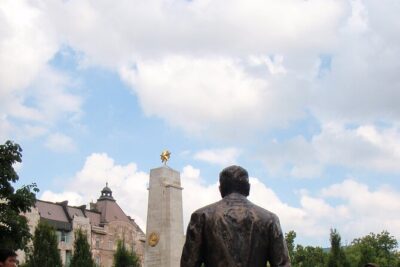
Liberty Square brings several political symbols into one compact area. The route discusses the Cold War near the US Embassy, the monument to the Soviet Army, the statue of Ronald Reagan, and an atomic shelter.
This is one of the strongest sections for visitors who want to understand how Budapest remembers the twentieth century. The Soviet monument recalls military power and occupation. The US Embassy points toward the wider Cold War standoff. The Reagan statue represents the later American role in challenging the Iron Curtain. Nearby Cold War defenses remind you that nuclear fear was not an abstract idea for people living in Europe.
The site works because the symbols do not tell one neat story. They reflect competing versions of liberation, occupation, alliance, and national survival. I would pay close attention to how your guide explains the Hungarian point of view, rather than treating the area as a collection of international political props.
The itinerary also lists a separate stop at the Ronald Reagan statue for around 10 minutes. That suggests the guide may return to or give extra attention to Reagan’s role, depending on the route. Hungarian gratitude toward Reagan is linked to his efforts to bring down the Iron Curtain, but the guide can place that belief within Hungary’s own experience rather than presenting it as a simple American victory lap.
More walking tours:
- Budapest: Buda Castle Walk with Saint Stephen’s Hall
★ 4.5 · 3,012 reviews - Big Bus Budapest Hop-On Hop-Off Bus and Walking Tour
★ 3.5 · 2,206 reviews - Budapest: Buda Castle District Walking Tour
★ 4.6 · 2,108 reviews - Budapest City Landmarks Walking Tour in 2 Hours
★ 5.0 · 2,048 reviews
Puskás Ferenc Stadium and socialist propaganda
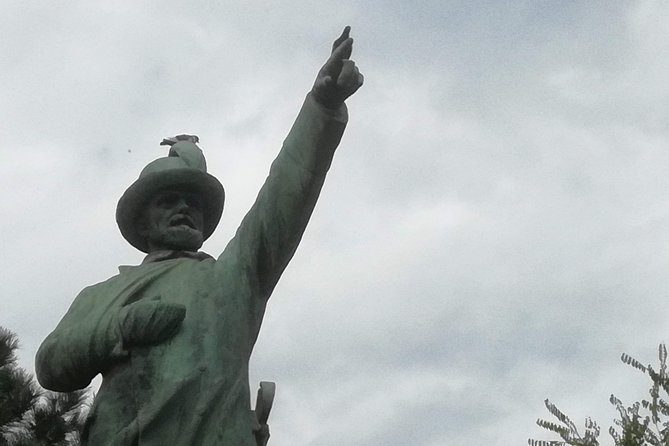
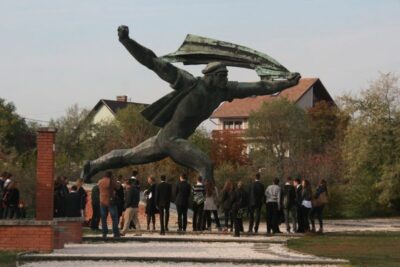
The former People’s Stadium, now Puskás Ferenc Stadium, gives the tour a change of mood. The site retains classic socialist realist statues, which provide a direct look at the visual language favored by the communist regime.
Socialist realism was not decoration for decoration’s sake. Statues and public buildings were meant to show the ideal citizen: strong, disciplined, athletic, productive, and loyal to the state. A sports stadium was an especially useful setting for that message. It joined physical fitness, national pride, mass gatherings, and political display.
May Day parades also form part of the wider story. Streets and public spaces were used for carefully staged demonstrations of unity, even when private opinion was more complicated. Your guide can help you read the scale and symbolism of these spaces instead of seeing only old concrete and oversized figures.
The stop lasts about 20 minutes and is free. It is a good reminder that communist Budapest was not only about police offices and political speeches. The system entered sports, art, education, architecture, and public ceremonies. If you are interested in design or urban planning, this section may be one of the tour’s most rewarding.
Bem József Square, where revolt found its voice
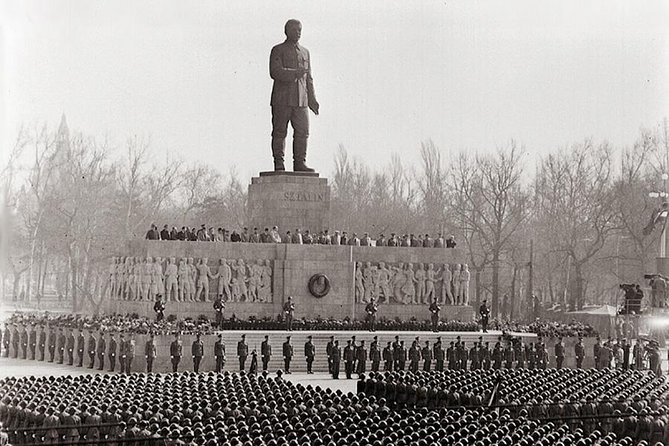
Bem József Square is one of the most important stops because it is tied directly to the opening of the 1956 uprising. The first large demonstration began here, making the square a place of action rather than just remembrance.
This is where the tour’s political story becomes human. Demonstrations need gathering points, shared slogans, recognizable meeting places, and a sense that other people are ready to act. A square can look quiet today, yet its role in a revolt changes how you see it.
The stop lasts about 25 minutes. There is also a coffeehouse on the square that has retained its original 1960s interior. That detail adds a welcome everyday touch. After discussing revolution and state power, you can picture the ordinary social spaces in which people met, talked, waited, and tried to maintain normal life.
Do not expect the coffeehouse to function as a separate included attraction unless your guide says otherwise. Its value is mainly visual and historical. The preserved interior helps ground the larger political story in daily routines.
The House of Terror as a powerful endpoint
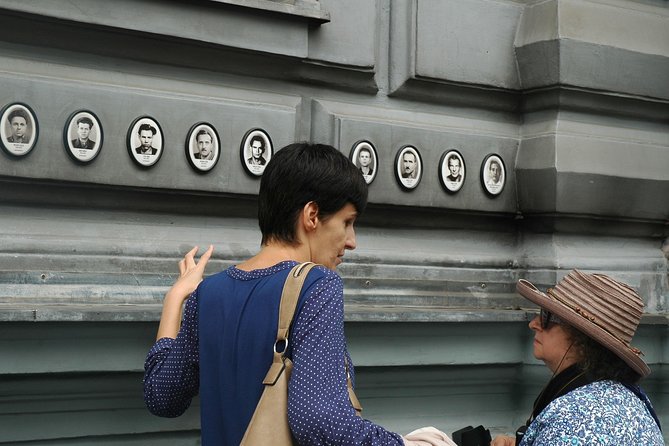
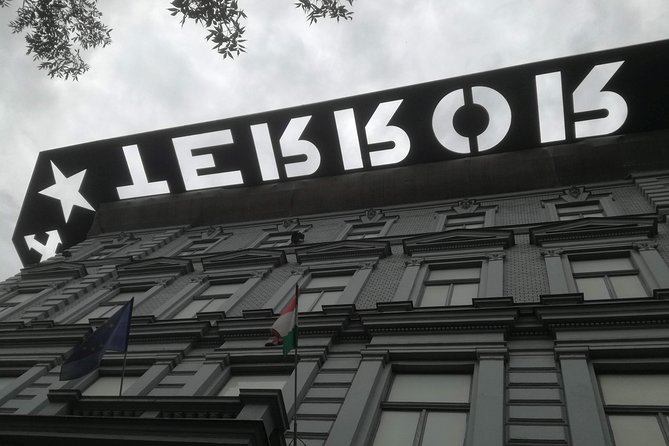
The walk concludes outside the House of Terror Museum at Andrássy út 60. The building served as the headquarters of Hungary’s communist secret services, and a section of the Berlin Wall is displayed in front of it.
The museum interior is not included. That is important when planning your day, because you will need a separate admission if you want to go inside. Still, ending here is a smart choice. The exterior gives the tour a final, serious focus on surveillance, interrogation, and political repression.
You may want to schedule the museum for after the walk, but the tour does not promise entry or enough time for a visit. If you plan to go inside, check the museum’s opening details separately and leave room for the length of the exhibition.
For me, the House of Terror works best after the outdoor stops. First you see public monuments, ceremonial spaces, stadium propaganda, and a revolution square. Then you arrive at the building connected with the secret services. The sequence moves from the state’s public image to the machinery that helped enforce it.
What the private format changes
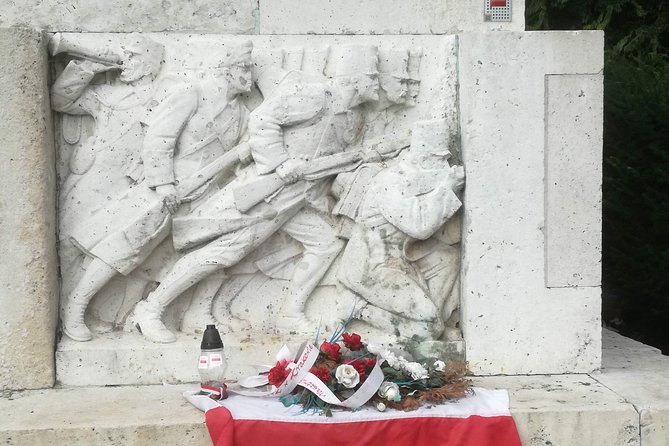
A private historian guide changes the tour from a fixed sightseeing circuit into a conversation. You can ask about family memories, censorship, shortages, architecture, the Soviet presence, or the transition of 1989. If your interest is narrow, the guide can spend more time on it.
The feedback about Andras is particularly useful. He is described as kind and extremely well informed, and he adjusted the route to match the group’s interests. Kata receives praise for clear explanations, a broad world view, humor, grace, and charm. Those qualities matter because political history can quickly become heavy. A guide who can explain difficult events without turning the walk into a lecture will make the three hours pass well.
The tour is offered in English. Morning and afternoon departures give you useful control over your Budapest schedule. An afternoon start could work well before an evening meal, while a morning walk may leave time for the House of Terror afterward.
The group-size information needs a quick check. The price is listed per group of up to 10, the highlights refer to a maximum of 6, and the operational information gives a maximum of 8 travelers. Because the experience is private, ask Insight Cities to confirm the exact number permitted for your booking.
Is $393.17 a fair price?
At first glance, $393.17 is a substantial amount for a three-hour walk. The value improves if you are sharing it among several people. Split between six people, it is about $65.53 each. Split between eight, it is about $49.15 each. A group of two, however, pays nearly $197 per person, so the economics are much less attractive.
You are paying for a private guide with a specialist subject, not just transport between landmarks. The price includes the three-hour guided walk, but not metro or tram tickets and not admission to the House of Terror Museum.
I would book it when you want context that a general city tour is unlikely to provide. The route covers several places that you might otherwise pass without understanding, including a housing estate, socialist statues, parade routes, and Cold War symbols. The guide’s ability to adjust the conversation is also more useful in a private group than in a large fixed tour.
If your main goal is to enter museums or see Budapest’s famous architecture, this may not be the best use of your budget. Much of the experience takes place outdoors, and the House of Terror remains an optional extra. You are paying for interpretation and connections between places.
Who will get the most from this walk?
I would recommend this experience to anyone with a serious interest in the Cold War, the 1956 uprising, Soviet influence, political monuments, or twentieth-century European history. It also suits repeat visitors who have already seen Parliament and the central sights and now want a more focused look at the city.
It should work well for families with older children, provided they are willing to listen and walk. The private setting lets you ask the guide to explain difficult subjects in a way that fits your group.
It is less suitable if you want a relaxed stroll with little political discussion. The themes include repression, surveillance, revolution, propaganda, and deprivation. You should expect thoughtful conversation, not a light sightseeing loop.
Wear comfortable shoes and keep your transport pass handy if you have one. If you do not, your guide will assist with tickets. Because pickup is available only from a central hotel or flat, confirm the meeting arrangement rather than assuming the guide will come to any address.
Should you book the Communist Budapest Private Walking Tour?
Book it if you want Budapest’s communist era explained through real places, not just a list of dates. The combination of 1956 sites, Cold War symbols, socialist public art, a housing estate, and the former secret service headquarters gives the subject both scale and everyday detail.
The strongest reason to choose it is the guide. Andras and Kata are praised for clear, thoughtful, personable presentations, and the private setup lets you shape the discussion. The main reasons to hesitate are the high cost for a very small group, extra transport and museum charges, and the need to confirm the actual group limit.
For a group of six or more with a genuine interest in modern Hungarian history, I think the price can be justified. For two people seeking only a quick introduction, a less expensive shared walk or museum visit may offer better value.
FAQ
How long is the Communist Budapest Private Walking Tour?
The guided walk lasts approximately three hours.
Is hotel pickup available?
Yes. The guide can meet you at a central hotel or flat and lead the group by metro, tram, or on foot. If you do not provide an address or do not want pickup, meet at Frankel Leó út 2-4, 1027 Budapest, 15 minutes before the start.
Are public transport tickets included?
No. Metro and tram tickets are not included, but the guide will help you purchase them if you do not already have a transport pass.
Does the tour enter the House of Terror Museum?
No. The tour concludes outside the House of Terror Museum. Museum admission is not included.
Is the tour offered in English?
Yes. The experience is offered in English.
Can I cancel for a full refund?
Yes, if you cancel at least 24 hours before the experience’s start time. Cancellations or changes made less than 24 hours before departure are not refunded or accepted.
Just added around Budapest
- Lake Balaton and Herend Guided Tour★ 4.7 · 3 reviews
- Audio visual multi-sensory chefs journey dinner experience★ 5.0 · 3 reviews
- Hollókő Ethnographic Village: Day Tour from Budapest★ 3.7 · 3 reviews
- Tapolca Cave Lake and Tihany/ Balaton private tour from Budapest★ 4.5 · 3 reviews
- Budapest Art Nouveau Walking Tour★ 5.0 · 3 reviews
- SzentEndre-SaintAndrew City Privately Shopping and Picturesque★ 4.5 · 3 reviews
- Budapest Drinks and Piano Show Cruise★ 4.5 · 3 reviews
- Horseshow on the Hungarian Puszta, private tour from Budapest with entry!★ 5.0 · 3 reviews
Communist History Tours, compared.
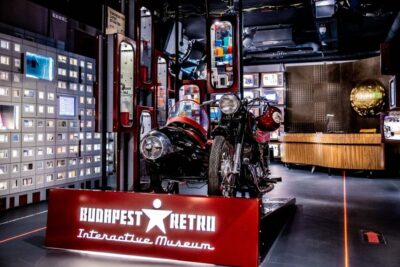
Communist History Tour with House of Terror Option
What we thought →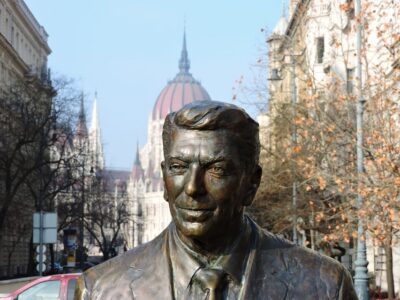
3-Hour Walking Tour About Communism (Small Group)
What we thought →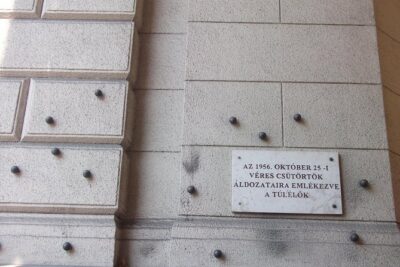
Lives of Hungarians Under Communist and Capitalist system
What we thought →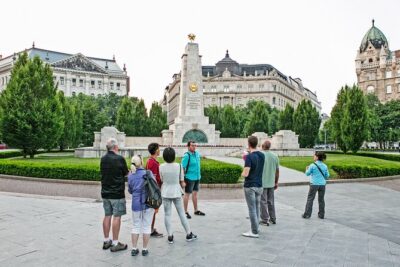
Private Budapest Hammer & Sickle Communist Times Tour
What we thought →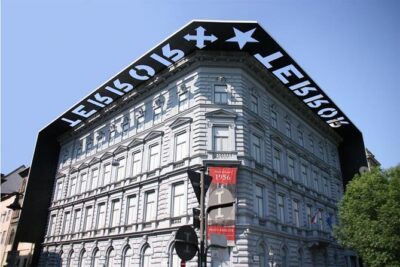
Browse the lists this tour appears in