
Reviewed · BUDAPEST
Hungary today: a no-taboo conversation
Skip the postcard version of Budapest. This 90-minute conversation at Bambi Café offers an honest look at Hungary’s move from Communism to democracy, along with the political, economic, and social questions shaping the country today. I like the small maximum of six people, which gives the meeting a personal feel, and I like that the discussion can follow your questions instead of sticking to a fixed script.
The main consideration is simple: this is a talk, not a sightseeing tour. You will not visit several landmarks or see Budapest from a guide’s usual route. If you want a thoughtful conversation with a Hungarian host, the price of $40.52 per person can be worthwhile. If you want a busy schedule of monuments and photos, this may feel too still.
In This Review
- Key points about the Bambi Café conversation
- Why this Budapest experience feels different
- Meeting at Bambi Café, a preserved slice of the 1970s
- The first half: Hungary from Communism to democracy
- The second half: your questions set the direction
- What the three recorded experiences suggest
- Is $40.52 a fair price for 90 minutes?
- Who will get the most from this experience?
- Practical details before you book
- My call: book it for conversation, not sightseeing
- FAQ
- Where does Hungary Today take place?
- What time does the experience begin?
- How long does the conversation last?
- Where does the experience end?
- How many people can join?
- What subjects are discussed?
- Can I ask controversial questions?
- Is food or a drink included?
- Is the experience accessible by public transportation?
- Can I cancel for a full refund?
Key points about the Bambi Café conversation

- A rare look at present-day Hungary: The discussion covers the fall of Communism, the shift to democracy, and the rise of the term illiberal democracy.
- A very small group: With no more than six people, you have a real chance to ask personal and difficult questions.
- A historic-feeling meeting place: Bambi Café has changed very little since the 1970s, giving the conversation a fitting setting.
- Hosts who encourage open questions: Daniel is praised for being friendly and well informed, while the hosts say they will try to answer anything honestly.
- A flexible format: You receive an introduction to modern Hungary, then help steer the conversation toward politics, economics, society, or the country’s future.
- Easy afternoon timing: The experience begins at 2:00 pm and ends back at Bambi Café after about 90 minutes.
Why this Budapest experience feels different
Budapest offers no shortage of grand buildings, river views, thermal baths, and guided walks. Those experiences help you see the city. This one aims to help you understand the country behind the sights.
I like that the conversation begins with Hungary’s recent past rather than treating politics as a separate subject. The change from Communism to democracy still shapes public life, business, political debate, and views about the future. Starting there gives you a useful frame for the rest of the discussion.
The experience then turns toward the present. You can ask about controversial politics, economic questions, the country’s uncertain future, ideas for change, or the host’s personal opinions. That openness is the main attraction. You are not simply listening to a prepared speech. You are taking part in a guided conversation.
The format also suits people who have already seen Budapest’s main sights. After a first visit, many questions become more specific. You may want to understand what political change means in daily life, how people view the country’s direction, or how Hungary’s past affects current choices. This meeting gives those questions room.
Other Budapest days people book alongside this one:
- Budapest: City Highlights Cruise with Welcome Drink
★ 4.6 · 35,610 reviews - Budapest: Unlimited Prosecco, Beer and Aperol Spritz Cruise
★ 4.8 · 25,310 reviews - Budapest: Széchenyi Spa Day Ticket with Optional Upgrades
★ 4.3 · 23,911 reviews
Meeting at Bambi Café, a preserved slice of the 1970s
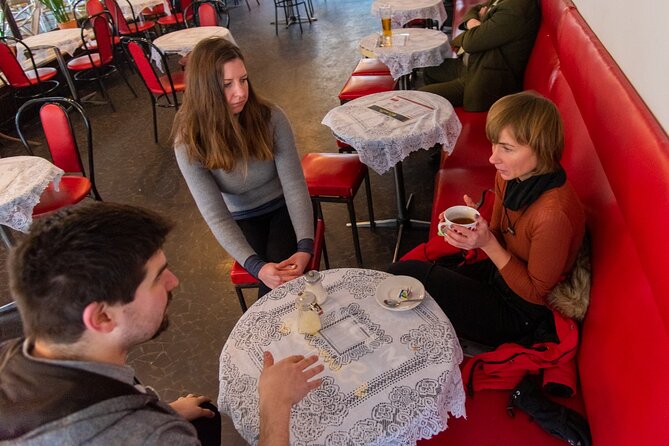
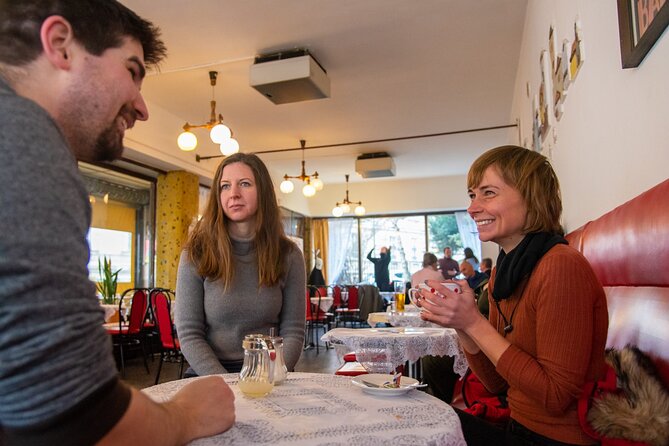
The conversation takes place at Bambi Café, at Frankel Leó út 2-4 in Budapest’s 1027 district. The café has changed very little since the 1970s, making it more than a convenient indoor meeting point.
That setting matters. A modern conference room would make the discussion feel formal and distant. Bambi Café provides a more everyday backdrop, one connected to the older Budapest that existed before the political changes discussed during the meeting. You can hear about the country’s past while sitting in a place that still carries a visual link to that period.
The available information does not promise a full café tour, a meal, or a particular drink. Think of Bambi primarily as the setting for the conversation. Admission to the café itself is included, but food and drinks are not described as part of the experience, so you should not book this expecting a tasting or a restaurant stop.
The meeting starts at 2:00 pm and finishes at the same location. Since the experience lasts about an hour and a half, you can fit it into an afternoon of sightseeing without giving up an entire day.
The first half: Hungary from Communism to democracy
The opening portion focuses mainly on Hungary’s modern era, with special attention to the last 30 years. The discussion includes the change from Communism to democracy, as well as historical, economic, and political developments.
This is an important choice. A quick city tour may mention 1989 and move on. Here, the political transition forms the starting point for understanding present-day Hungary. You can expect the host to explain the broad changes that followed the end of Communist rule and how those changes connect to current debates.
The conversation also addresses the creation of the phrase illiberal democracy in Hungary in recent years. That subject can be politically sensitive, but it is central to the experience. The hosts make clear that controversial questions are welcome rather than off limits.
I appreciate the promise of an introduction before the open discussion. You do not need to arrive with a perfect list of questions or a degree in political science. If you know little about Hungary’s recent history, the opening section should give you a starting point. If you already know the basics, it can help you frame sharper questions for the second half.
Still, the exact amount of time spent on each subject depends on the group. You may receive a broad introduction or spend longer on one issue that catches everyone’s attention. That flexibility is useful, but it also means the experience is less predictable than a standard sightseeing tour.
The second half: your questions set the direction
After the introduction, the format becomes a conversation. You can ask about politics, the country’s turbulent past, the economy, its future, or possible changes. You can also ask for the host’s personal opinion.
This is where the group size becomes important. Six people is small enough for each person to speak, although the quality of the exchange will depend partly on how active the group is. If everyone arrives with questions, the 90 minutes may pass quickly. If you are the only person eager to talk, you may have more time to guide the subject.
Daniel is specifically praised for his friendly and informative approach. One participant felt the discussion could have continued for several more hours, which suggests that the conversational format can encourage extended questions rather than short, rehearsed answers. Another account describes the meeting as a rare chance to speak with a Hungarian citizen who has a broad understanding of Hungary and the wider world.
You should still keep your expectations sensible. A 90-minute meeting cannot answer every question about a country. It can, however, help you identify the questions that matter and give you a more personal way to think about the country’s current direction.
This format may be especially useful if you feel that official tours often avoid politics. The hosts present the experience as honest and open, but the views shared are still personal opinions. You are not receiving a neutral government briefing or an academic lecture. You are entering a frank exchange with local hosts.
A completely different kind of day out around Budapest:
- Budapest: Nighttime or Daytime Sightseeing Cruise
★ 4.2 · 21,062 reviews - Budapest: 1-Hour Evening Sightseeing Cruise with Drink
★ 4.5 · 8,330 reviews - Budapest Danube Cruise and Dinner Options, Live Music and Dance
★ 4.5 · 7,428 reviews - Budapest: Historic Cruise with Welcome Drink
★ 4.7 · 6,512 reviews
What the three recorded experiences suggest
The strongest praise centers on the depth of the discussion and the quality of the host. One person described it as the best experience of a packed week in Budapest, largely because it offered a serious conversation with a Hungarian citizen rather than another pass through famous sights.
Another person singled out Daniel as friendly, informative, and able to explain contemporary Hungary clearly. The same participant wanted to keep talking for several more hours. That is a useful clue for you: this experience is likely to appeal most if you enjoy asking follow-up questions and listening to detailed answers.
A French-language account describes the broader time in Hungary as a beautiful experience and speaks warmly about Budapest, Lake Balaton, and the country’s welcoming people. It does not provide the same detail about the conversation itself, but it supports the idea that the experience can fit well into a wider interest in Hungarian life and culture.
The overall rating is 5 from three recorded ratings. That is encouraging, but the number is small. I would treat the score as a positive sign rather than proof that every person will enjoy the format. People who prefer movement, monuments, or structured commentary may want something else.
Is $40.52 a fair price for 90 minutes?
At $40.52 per person, this is not the cheapest way to spend an afternoon in Budapest. You are paying for access to a small, personal discussion rather than for transport, attraction tickets, or a long route through the city.
The price makes more sense if you value local conversation and want to ask questions that ordinary sightseeing tours may not cover. With a maximum of six people, the cost buys a more focused setting than a large coach group. The host’s time is the main product.
I would compare it with the cost of a private guide or a longer specialist tour, though the available details do not provide prices for those alternatives. Unlike a walking tour, this experience does not give you a series of views or physical landmarks. Its value comes from context, frank answers, and the chance to discuss modern Hungary directly.
For a first-time visitor on a tight budget, the price may be difficult to justify. You can see many of Budapest’s major public sights without paying this amount. For someone who has already covered the classic attractions, or who cares strongly about politics and recent history, the calculation changes.
The small group is important here. If the meeting filled with six people, you would still have a far more personal setting than a mass tour, but you would not have unlimited time to speak. The experience promises a maximum, not a private meeting.
Who will get the most from this experience?
I would recommend this conversation to you if you fit one or more of these descriptions:
- You have already visited Budapest’s main sights and want a better sense of present-day Hungary.
- You know something about the country’s modern history and want to ask more precise questions.
- You enjoy politics, economics, and social issues as part of your travel.
- You prefer a small discussion to a scripted tour.
- You want to hear a local person’s personal views, including opinions on difficult topics.
- You are comfortable with an experience that may change direction based on the group.
It may be less suitable if you want a family attraction, constant activity, panoramic views, or a detailed introduction to medieval and imperial Budapest. The focus is firmly on the modern era, especially the last three decades.
You should also think about your preferred role. This is not designed only for quiet listening. You can ask anything, and the best value likely comes from arriving with a few questions. They need not be polished. A simple question about daily life, politics, economics, or future possibilities can open a useful exchange.
Practical details before you book
You meet at Bambi Café, Frankel Leó út 2-4, 1027 Budapest. The activity ends at the same place, so you do not need to plan for a separate return point.
A mobile ticket is provided, and confirmation arrives when you book. The café is near public transportation, which makes the meeting point practical for an afternoon appointment. The stated start time is 2:00 pm, and the duration is about 1 hour and 30 minutes.
Most people can take part, and service animals are allowed. The group limit is six people. Since no special physical requirements are described, the main thing to prepare is mental rather than physical: bring curiosity and a willingness to discuss subjects that may be politically sensitive.
You can cancel for a full refund if you do so at least 24 hours before the local start time. Cancellations or changes made less than 24 hours before the experience are not refunded or accepted.
My call: book it for conversation, not sightseeing
I would book Hungary Today if I wanted a direct, thoughtful discussion about Hungary’s recent past and present. The small group, flexible structure, and Bambi Café setting give it a personal character that a standard city tour cannot match.
I would skip it if I had only one short afternoon in Budapest and had not yet seen the city’s main sights. I would also skip it if politics and economics were not subjects I wanted to discuss while on holiday.
For the right person, $40.52 is a fair price for access to an open conversation with hosts such as Daniel, especially when the group stays small. Go prepared with questions, allow the discussion to wander a little, and you may leave with a clearer sense of how Hungary sees itself today.
FAQ
Where does Hungary Today take place?
It takes place at Bambi Café, Budapest, Frankel Leó út 2-4, 1027 Hungary.
What time does the experience begin?
The stated start time is 2:00 pm.
How long does the conversation last?
The experience lasts approximately 1 hour and 30 minutes.
Where does the experience end?
It ends back at Bambi Café, the meeting point.
How many people can join?
The activity has a maximum of six people.
What subjects are discussed?
The conversation can cover Hungary’s move from Communism to democracy, the last 30 years, politics, economics, the country’s past, its future, and ideas for change.
Can I ask controversial questions?
Yes. The hosts say you can ask anything you have wanted to know about Hungary, including controversial politics and personal opinions.
Is food or a drink included?
The provided details do not state that food or drinks are included. Admission to Bambi Café is listed as free.
Is the experience accessible by public transportation?
The meeting point is near public transportation.
Can I cancel for a full refund?
Yes, if you cancel at least 24 hours before the experience’s local start time. Cancellations made less than 24 hours before the start are not refunded.
Just added around Budapest
- Lake Balaton and Herend Guided Tour★ 4.7 · 3 reviews
- Audio visual multi-sensory chefs journey dinner experience★ 5.0 · 3 reviews
- Hollókő Ethnographic Village: Day Tour from Budapest★ 3.7 · 3 reviews
- Tapolca Cave Lake and Tihany/ Balaton private tour from Budapest★ 4.5 · 3 reviews
- SzentEndre-SaintAndrew City Privately Shopping and Picturesque★ 4.5 · 3 reviews
- Budapest Art Nouveau Walking Tour★ 5.0 · 3 reviews
- Budapest Drinks and Piano Show Cruise★ 4.5 · 3 reviews
- Horseshow on the Hungarian Puszta, private tour from Budapest with entry!★ 5.0 · 3 reviews