
Reviewed · WALKING TOURS
Budapest Art Nouveau Walking Tour
Budapest wears its rebellion in porcelain. This three-hour walk reveals the city’s distinctive Hungarian Secession style through ornate facades, Asian motifs, and clever early modern design. I especially like the focus on Ödön Lechner’s Postal Bank and the close look at Zsolnay ceramics, details that make Budapest’s Art Nouveau different from Paris or Vienna.
The tour also brings you inside parts of Gresham Palace, where the entrance hall gives you more than a quick street view. An art and architecture historian leads the walk, and guide Anna received particular praise for her friendly manner and strong knowledge of Budapest’s art and history.
The main consideration is timing. Some interiors depend on the day, and extra admission fees can apply to the House of Hungarian Art Nouveau or the Orthodox Synagogue. Weekend visits may also miss the Hungarian National Bank and the synagogue’s interior on Saturdays.
In This Review
- Key points to know before booking
- Why Budapest’s Art Nouveau deserves a dedicated walk
- Bedő House and the smaller details of Hungarian Secession
- The Hungarian State Treasury and the practical beauty of public architecture
- Gresham Palace, Budapest’s grand Art Nouveau calling card
- Rózsavölgyi utca and the role of shops and interiors
- Thonet House and the sparkle of Zsolnay ceramics
- Paris Passage and Budapest’s theatrical interiors
- The Kazinczy Street Orthodox Synagogue finale
- How much value does the $123 price offer?
- Who will enjoy this walk most?
- Practical advice for choosing your date
- Should you book the Budapest Art Nouveau Walking Tour?
- FAQ
- How long is the Budapest Art Nouveau Walking Tour?
- What language is the tour offered in?
- Is the tour private or shared?
- Is hotel pickup available?
- Are tram and metro tickets included?
- Is the guide a historian?
- Can I visit Gresham Palace from the inside?
- Is the Orthodox Synagogue open every day?
- Are admission fees included?
- What happens if a building is closed?
Key points to know before booking
- Ödön Lechner’s Postal Bank introduces you to Hungary’s bold national version of Art Nouveau, filled with color, porcelain, and eastern references.
- Gresham Palace offers one of the best chances to see Art Nouveau details from inside, not just from the pavement.
- Zsolnay porcelain tiles explain much of the style’s sparkle, especially on the facades of Budapest’s grand public buildings.
- Bedő House and the House of Hungarian Art Nouveau add smaller-scale interiors and applied arts to the walk.
- The route may change by day, particularly on weekends when some buildings are closed.
- A private or small-group format makes the three-hour tour a good fit for travelers who want questions answered rather than a large-group lecture.
Why Budapest’s Art Nouveau deserves a dedicated walk
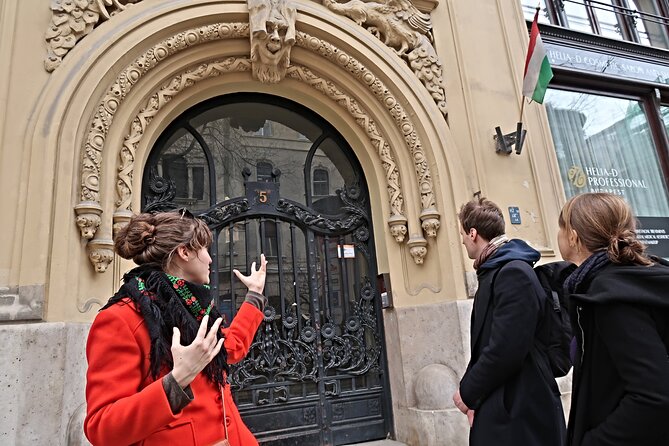
Budapest’s Art Nouveau is not merely a collection of pretty buildings. It reflects a city eager to prove its place among Europe’s leading capitals at the turn of the 20th century.
The style arrived during a period of confidence and expansion. Wealthy banks, public offices, shops, and apartment buildings wanted a fresh look. Instead of copying classical Rome or Renaissance Florence, Hungarian designers reached for flowing lines, folk references, ceramics, floral patterns, and Asian-inspired forms.
I find that context important because the facades can seem wildly decorative at first glance. Once you understand the ideas behind them, the shapes become easier to read. The rooflines, tiles, mosaics, metalwork, and repeated plant forms were part of a deliberate break from older architectural rules.
Your guide helps make those connections. This is not a walk where you simply photograph a facade and move on. You stop to consider why Hungarian architects used certain materials, how the buildings expressed national identity, and how Budapest’s version of Art Nouveau fit into a wider European movement.
The tour lasts three hours, long enough to make the subject clear without turning into an all-day architecture seminar. You will walk between central locations, with some public transportation possibly needed. Tram and metro tickets are not included, so keep that small cost in mind.
More walking tours:
- Budapest: Buda Castle Walk with Saint Stephen’s Hall
★ 4.5 · 3,012 reviews - Big Bus Budapest Hop-On Hop-Off Bus and Walking Tour
★ 3.5 · 2,206 reviews - Budapest: Buda Castle District Walking Tour
★ 4.6 · 2,108 reviews
Bedő House and the smaller details of Hungarian Secession
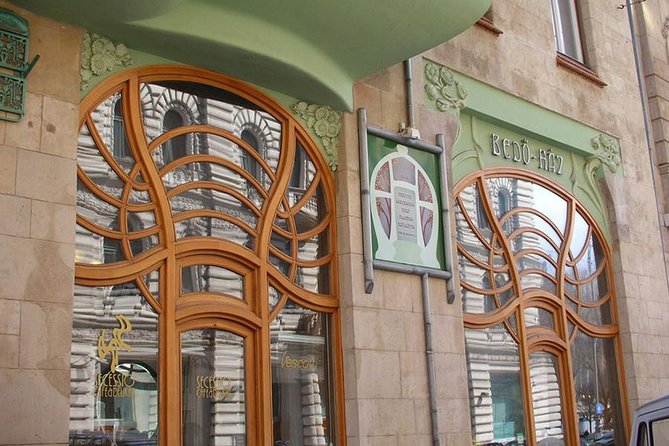
Bedő House gives the walk an appealing start because it shows how Art Nouveau worked at a more intimate scale. The building is associated with the House of Hungarian Art Nouveau, which includes an art nouveau museum and coffee house.
That combination matters. You are not only looking at a large civic building from the street. You may also see how the style appeared in decorative objects, furnishings, ceramics, and interior design.
The museum admission is listed at 1,000 HUF per person when it is open as part of the visit. That fee is modest, but it is not included in the tour price. Ask at booking or before the walk begins if this stop is planned for your date.
I like this part of the route because it gives you a visual vocabulary for the larger buildings that follow. Look for curves, floral decoration, unusual color combinations, and the way practical objects were made decorative. Art Nouveau aimed to bring art into everyday life, not reserve it for museums.
The coffee house also adds a useful pause. After several facades, you can consider the movement through smaller objects and interior spaces. Do not expect a vast museum. The appeal is its focused subject and its connection to the buildings around it.
The Hungarian State Treasury and the practical beauty of public architecture
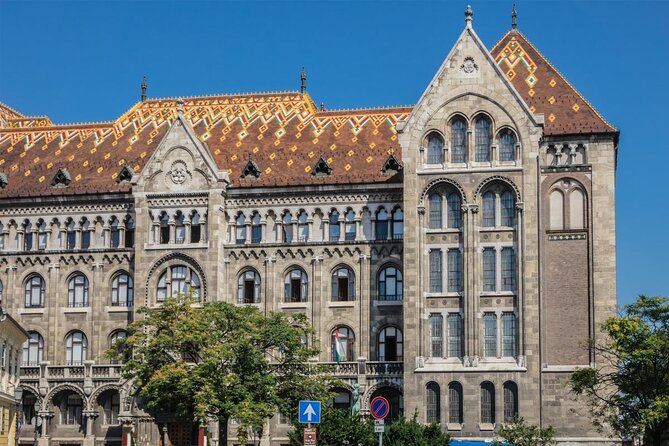
The Hungarian State Treasury, also identified with the Palace of the Royal Post, is one of the tour’s major architectural highlights. Ödön Lechner designed it, and he is often called Hungary’s Gaudi because of his daring use of shape, color, and ornament.
The building’s importance comes from the way it joins public purpose with theatrical design. This was a working institution, yet its exterior was given the visual energy of a palace. The roof decoration and ceramic surfaces make the structure feel lighter and more playful than a conventional government office.
Zsolnay porcelain is central here. Made in Pécs in southern Hungary, the material became one of the signatures of Hungarian Art Nouveau. It could handle color and surface decoration in ways that ordinary building materials could not.
Your guide will point out how the ceramics function on the facade. They are not simply pasted-on decoration. They help create a complete visual program, one where the roof, walls, windows, and ornamental details work together.
This is also where the tour’s discussion of Asian motifs becomes especially useful. Hungarian designers drew on the idea that the Hungarian people had eastern origins. They also worked within a broader European taste for Orientalism. That does not mean the buildings reproduce Asian architecture exactly. Instead, designers borrowed shapes, patterns, and visual references to create something that felt both modern and connected to Hungary’s identity.
The interior access may be limited to an entrance hall or selected areas. That is still worthwhile, but you should not expect a full tour of every room in an active public building.
Gresham Palace, Budapest’s grand Art Nouveau calling card
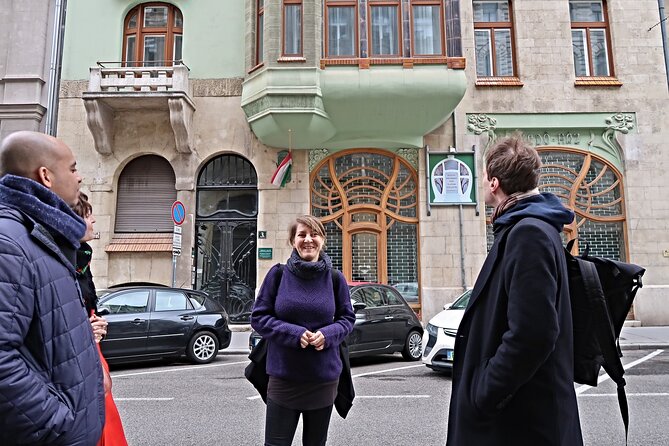
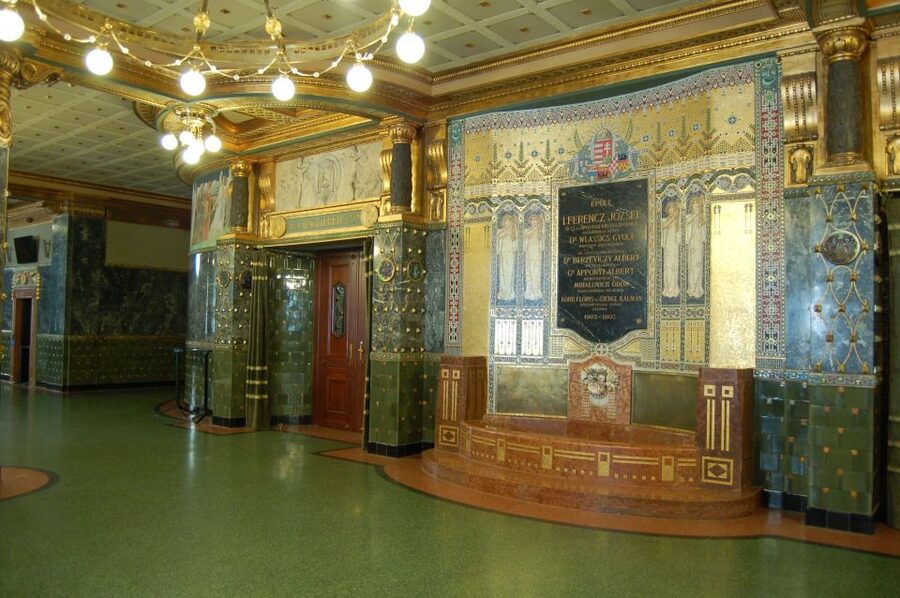
Gresham Palace is the most polished stop for many people on the walk. Its facade is elegant and detailed, while its entrance hall gives you a chance to see the style from inside.
The palace was built as a prestigious commercial and residential complex, and its design reflects that purpose. This was architecture meant to impress clients, residents, and passersby. The decorative program is refined rather than rustic, with careful metalwork, glass, stone, and tile details.
I like the contrast between Gresham Palace and Lechner’s more exuberant work. The two buildings show that Budapest’s Art Nouveau was not one fixed look. Some architects favored strong color and national motifs. Others created a more luxurious, cosmopolitan style suited to a major city.
Your guide can help you slow down at the entrance hall. Look above eye level, where decorative details are easy to miss when you are simply trying to find your way through the doorway. Notice how the materials meet, how light works across the surfaces, and how ordinary building features become part of the design.
Access to the interior can depend on current conditions. The tour information indicates that visitors can generally enter the entrance hall, but this is not a promise of access to private or restricted spaces. If interior architecture is your main reason for booking, ask about the expected access on your date.
A completely different kind of day out around Budapest:
- Budapest: City Highlights Cruise with Welcome Drink
★ 4.6 · 35,610 reviews - Budapest: Unlimited Prosecco, Beer and Aperol Spritz Cruise
★ 4.8 · 25,310 reviews - Budapest: Széchenyi Spa Day Ticket with Optional Upgrades
★ 4.3 · 23,911 reviews - Budapest: Nighttime or Daytime Sightseeing Cruise
★ 4.2 · 21,062 reviews
Rózsavölgyi utca and the role of shops and interiors
Rózsavölgyi utca adds a different kind of stop. The route includes a flower shop with its original interior, along with a department store, bank offices, and other examples of Art Nouveau design.
These places help you see how the style reached beyond monumental buildings. A flower shop could use the same language of curves, ornament, and crafted surfaces found in a bank or palace. That is one of the movement’s most appealing ideas: architecture, furniture, signage, and commercial design should belong to the same artistic world.
The original interior is especially useful because street facades can hide the best details. You might find decorative fittings, patterned surfaces, and carefully designed displays that make the shop feel like a complete work of art.
The department store and bank offices show the connection between Art Nouveau and modern commerce. Budapest was growing more affluent and cosmopolitan, and businesses wanted interiors that signaled quality and confidence. At the same time, this style was not only for aristocratic homes. It appeared in places meant for shopping, banking, and daily business.
I would pay attention to the guide’s explanations here. Without context, a bank doorway may look like one more ornate entrance. With context, you can see how design communicated trust, prosperity, and modernity.
Thonet House and the sparkle of Zsolnay ceramics
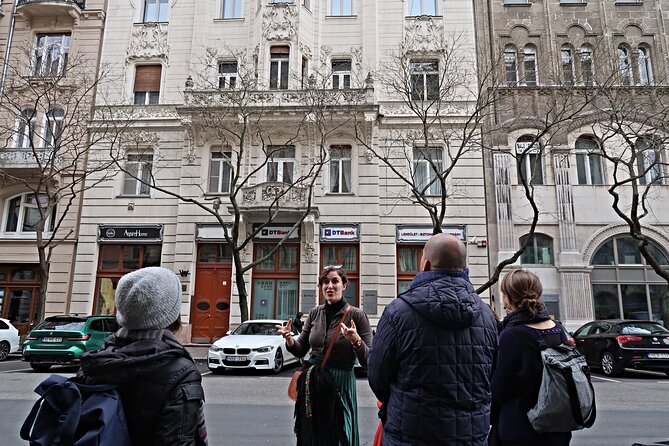
Thonet House is a particularly good stop for understanding materials. Its facade uses Zsolnay porcelain tiles, a feature that gives Hungarian Art Nouveau much of its distinctive color and shine.
Porcelain was more than a decorative luxury. It was durable, weather-resistant, and capable of carrying intricate patterns. That made it well suited to facades, where ordinary paint or plaster could not create the same effect.
You will see why Hungarian architects valued the Pécs-based Zsolnay factory so highly. The ceramics brought a crafted, almost jewelry-like quality to large buildings. They also helped designers move away from the gray stone and strict symmetry common in older architecture.
This is a good place to ask about maintenance and preservation. Bright ceramic surfaces can change the character of an entire street, but they also require care. The tour does not promise a technical conservation lesson, yet the material itself opens the door to that discussion.
For photographers, Thonet House is a rewarding stop because the details are close enough to study. Wide shots show the overall composition, while a closer look reveals the texture and pattern of the tiles. I would keep your camera ready, but do not let it replace the guide’s explanation.
Paris Passage and Budapest’s theatrical interiors
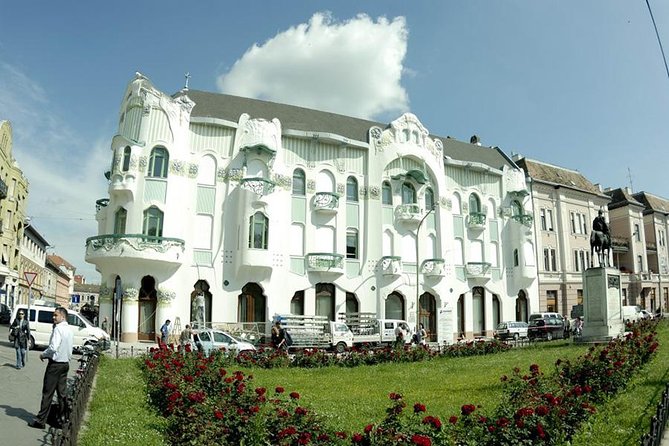
Paris Passage brings the walk indoors again, with a setting that shows how Art Nouveau could turn a passageway or commercial space into a dramatic experience.
The route also includes several bank offices and a small art nouveau museum and coffee house. Together, these places create a useful contrast between public grandeur and everyday design. You get to see how the movement shaped places where people conducted business, shopped, met friends, and passed through the city.
Passages are especially effective for architecture walks because they bring different surfaces close to eye level. You can study railings, windows, tilework, lettering, and decorative transitions without standing across a busy street.
The condition of access matters here too. Some interiors may be open only at certain times, and the guide may adjust the route if a building is unavailable. That flexibility is a benefit of a private or small-group format, but it also means your exact sequence may differ from the advertised outline.
The Kazinczy Street Orthodox Synagogue finale
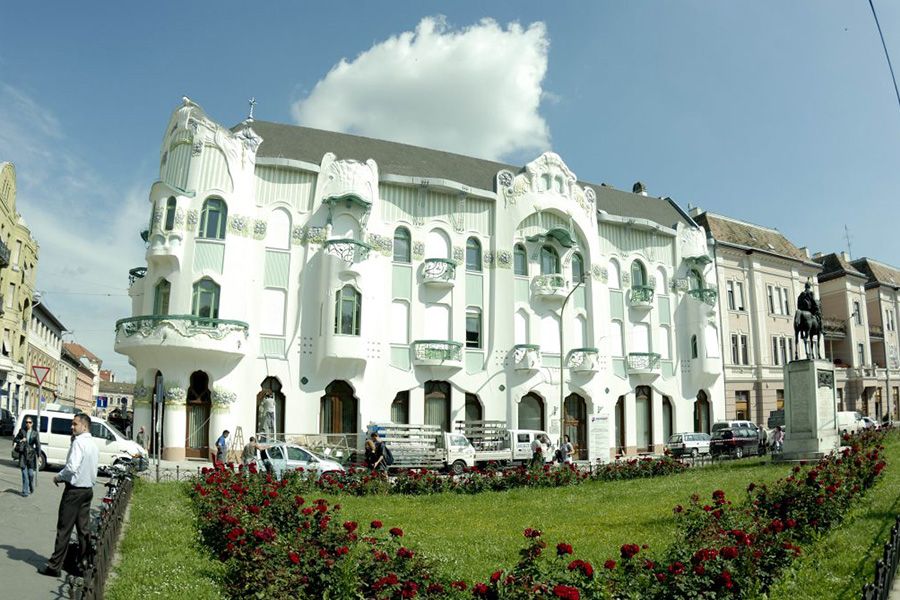
The Orthodox Synagogue on Kazinczy Street provides a strong closing point because its Art Nouveau interior shows how the style could shape a sacred space.
The synagogue is described as a small but exquisite example, with an interior that rewards close attention. Rather than judging it only from the exterior, you can consider how ornament, color, pattern, and structure work together in a religious setting.
The admission fee is 2,000 HUF per person when entry is included, and this cost is separate from the tour price. The synagogue is closed on Saturdays, so Saturday guests should expect an adapted route or an alternative stop.
The tour may also be adjusted to include other Art Nouveau sites, such as the Gellért Bath Hotel, the Museum of Applied Arts, or the Geology Museum. Which substitute appears depends on the day and the guide’s planning. That flexibility is useful, especially if a key interior cannot be visited.
How much value does the $123 price offer?
At $123 per person, this is not a budget walking tour. The price makes more sense if you choose a private or small-group format and have a real interest in architecture, design, or Budapest’s cultural development.
You are paying for three hours with a historian guide, not just a route between famous facades. A good guide can point out details you would miss, explain the relationship between Lechner and Zsolnay ceramics, and make sense of the Asian references that appear throughout the style.
The value also depends on access. If you enter Gresham Palace, the State Treasury entrance hall, a museum, and the synagogue, the tour offers a stronger mix of exterior and interior viewing. If several buildings are closed, the guide can adapt the walk, but the experience may feel more like a street architecture tour.
Extra entry fees are relatively small in Hungarian forints, but you should budget for them. Tram and metro tickets are also separate. Free cancellation up to 24 hours before the start and the option to reserve now and pay later reduce the risk if your Budapest schedule is still shifting.
Who will enjoy this walk most?
I would recommend this experience to you if you enjoy noticing materials, patterns, and design choices rather than rushing from one major sight to the next.
It suits:
- Architecture and design enthusiasts
- Visitors who want more than Budapest’s standard highlights
- People interested in Hungarian identity and national art
- Repeat visitors looking for a fresh theme
- Small groups that prefer questions and flexible pacing
- Museum fans who enjoy connecting objects with real buildings
It may be less suitable if you want a general introduction to Budapest, dislike walking between central sites, or prefer a tour with guaranteed access to every interior. The subject is focused, and much of the enjoyment comes from looking carefully at details.
The English-language guide is another factor. The experience is offered in English, and private or small groups are available. One guide, Anna, was specifically praised for being friendly and highly informed about Budapest’s art and history. A separate five-star booking praised the guide’s strong German skills, though the listed tour language is English, so confirm language needs before booking.
Practical advice for choosing your date
Try to avoid Saturday if the Orthodox Synagogue is a priority. The Hungarian National Bank is also closed on weekends, and it contains fine examples of Zsolnay porcelain.
A weekday may give you the best chance of seeing the full range of interiors. Still, opening conditions can change, so confirm the planned route before setting your expectations too firmly.
Wear comfortable shoes. The tour lasts three hours and involves walking between several central locations. Carry a little extra money for public transport and possible admissions, and leave room in your schedule if the guide adapts the route.
The optional pickup service can begin from your hotel or holiday flat. If you prefer a central meeting point, the tour can arrange a meeting at Madal Café on Alkotmány u. 4. The starting point depends on the option you select.
Should you book the Budapest Art Nouveau Walking Tour?
Book it if you want Budapest explained through its buildings, materials, and artistic ambitions. The strongest reasons are the chance to study Lechner’s work, see Zsolnay ceramics up close, enter parts of Gresham Palace, and finish with a memorable synagogue interior when the schedule permits.
I would choose a weekday, confirm which interiors are open, and ask whether the route includes the House of Hungarian Art Nouveau or the synagogue. At $123, it is a specialist tour rather than a cheap sightseeing walk, but the price can be fair for a private or small-group experience led by a strong historian.
Skip it if you only want a quick look at Budapest’s main landmarks. Choose it if you want to understand why the city’s Art Nouveau feels so Hungarian: colorful, inventive, proudly local, and willing to cover a working bank in porcelain.
FAQ
How long is the Budapest Art Nouveau Walking Tour?
The walking tour lasts three hours.
What language is the tour offered in?
The listed tour language is English.
Is the tour private or shared?
Private and small-group options are available.
Is hotel pickup available?
Pickup is optional. If you prefer a central meeting point, the group can meet at Madal Café, Budapest, Alkotmány u. 4.
Are tram and metro tickets included?
No. Tram and metro tickets are not included in the tour price.
Is the guide a historian?
The experience includes a historian guide with a focus on art and architecture.
Can I visit Gresham Palace from the inside?
The tour information indicates that visitors can enter the entrance hall, allowing you to see some interior Art Nouveau details. Access beyond that area is not specified.
Is the Orthodox Synagogue open every day?
No. The Orthodox Synagogue on Kazinczy Street is closed on Saturdays.
Are admission fees included?
The listed tour price does not include possible admission charges for the House of Hungarian Art Nouveau or the Orthodox Synagogue. The stated fees are 1,000 HUF for the House of Hungarian Art Nouveau and 2,000 HUF for the synagogue.
What happens if a building is closed?
The route can be adapted to your interests or extended to other Art Nouveau sites, including the Gellért Bath Hotel, the Museum of Applied Arts, and the Geology Museum.
Just added around Budapest
- Lake Balaton and Herend Guided Tour★ 4.7 · 3 reviews
- Audio visual multi-sensory chefs journey dinner experience★ 5.0 · 3 reviews
- Tapolca Cave Lake and Tihany/ Balaton private tour from Budapest★ 4.5 · 3 reviews
- Hollókő Ethnographic Village: Day Tour from Budapest★ 3.7 · 3 reviews
- SzentEndre-SaintAndrew City Privately Shopping and Picturesque★ 4.5 · 3 reviews
- Budapest Drinks and Piano Show Cruise★ 4.5 · 3 reviews
- Horseshow on the Hungarian Puszta, private tour from Budapest with entry!★ 5.0 · 3 reviews
- Hungary today: a no-taboo conversation★ 5.0 · 3 reviews
Walking Tours, compared.
Big Bus Budapest Hop-On Hop-Off Bus and Walking Tour
What we thought →
Budapest City Landmarks Walking Tour in 2 Hours
What we thought →
3-Hour Orientation Walking Tour of Buda and Pest
What we thought →
Budapest Historical Sightseeing – Free Walking Tour
What we thought →
Budapest All in One Small Group Walking Tour with Strudel Stop
What we thought →Browse the lists this tour appears in