
Reviewed · JEWISH QUARTER TOURS
Budapest Festive and Old Jewish District Self-Guided Walking Tour
Budapest changes mood street by street. This self-guided walk links Andrassy Avenue’s grand buildings with the old Jewish quarter’s food, bars, and memorial history, using your smartphone instead of a live guide. I like the freedom to start when you wish, and I like that the route ends at Szimpla Kert, Budapest’s best-known ruin bar. The main drawback is simple: the app connection must work, and one booking had trouble linking to it despite repeated customer-service messages.
The tour costs $14.47 per person and takes about 90 minutes. I would treat it as a good-value orientation walk, not a full synagogue visit or a substitute for a museum tour. Admission to the House of Terror Museum is not included, and the route gives each stop only a short introduction.
In This Review
- Key points to know before you go
- A self-guided route with a clear sense of place
- Starting at the House of Terror Museum
- Andrassy Avenue and the Budapest version of a grand boulevard
- Jókai Street and a taste of Hungarian naming
- The Hungarian State Opera and Parisian inspiration
- Entering the old Jewish quarter
- Gozsdu Passage, food, bars, and people-watching
- The Great Synagogue and the Jewish community of Budapest
- Ending at Szimpla Kert, Budapest’s famous ruin bar
- What the audio format does well
- Is $14.47 a fair price?
- Who should choose this Budapest walk?
- Practical timing and cancellation advice
- Should you book it?
- FAQ
- How long does the Budapest Festive and Old Jewish District tour take?
- What is the price of the tour?
- Where does the walking tour begin?
- Where does the tour end?
- Is admission to the House of Terror Museum included?
- Does the tour include entry to the Great Synagogue?
- Can I cancel for a full refund?
Key points to know before you go
- Your phone is the guide: Stories created by professional guides and actors play automatically through the Rewind app as you move along the route.
- A useful west-to-east route: Begin near Vörösmarty Street, pass Andrassy Avenue and the Opera, then finish in the old Jewish quarter.
- The Great Synagogue is a landmark, not an included interior visit: The stop introduces the synagogue and the Jewish quarter, but admission is not listed as part of the walk.
- Szimpla Kert is the finale: You finish at Kazinczy Street 14, beside the city’s most famous ruin bar.
- Flexible private format: It is designed for your group alone, with no fixed departure time shown.
- Allow time for setup: The app is central to the experience, so connect your booking before you set off.
A self-guided route with a clear sense of place
I like this walk because it shows two very different faces of central Budapest. The first part moves through the polished city of Andrassy Avenue, the Opera, and Oktogon. The second part brings you into the old Jewish quarter, now widely known for its restaurants, bars, street life, and ruin pubs.
That change is the point. You do not simply collect nine disconnected sights. You move from formal nineteenth-century Budapest into a district shaped by Jewish life, war, political change, renewal, and nightlife. The audio stories give you a thread to follow while the streets provide the visual detail.
The route is listed as approximately 1 hour and 30 minutes. The nine stops are each allotted about five minutes, so part of the time is walking between them. I would not rush. The app may move you onward automatically, but you still control your pace, and the old Jewish quarter deserves a slower look than the timetable suggests.
Because this is self-guided, you can begin at any time during the listed operating window, from 12:00 AM to 11:30 PM daily. That broad schedule suits an early afternoon walk, a rainy-day outing, or a pre-dinner route through the district.
More Jewish Quarter walks:
- Budapest Jewish Heritage Memorial Walking Tour & Synagogue Entry
★ 5.0 · 568 reviews - Budapest: Jewish Heritage Guided Tour with Synagogue Ticket
★ 4.8 · 533 reviews - Jewish Quarter of Budapest Walking Tour
★ 4.7 · 369 reviews
Starting at the House of Terror Museum
The walk begins at Budapest, Vörösmarty u. 37, near the House of Terror Museum. The museum deals with Hungary’s communist period and the political forces that shaped the country in the twentieth century.
The tour allows about five minutes here, and admission is not included. That matters. You should think of this as an exterior introduction unless you decide to buy a separate museum ticket and return at another time. Five minutes is enough to get the basic context, but not enough for the museum itself.
I appreciate this starting point because it gives the route a serious opening. The walk is not only about cafés and nightlife. Budapest’s modern identity was shaped by political upheaval, and the House of Terror provides an early reminder of that.
If you want to visit inside, plan for extra time beyond the 90-minute route. The tour price does not cover entry, and the experience does not promise a guided museum visit.
Andrassy Avenue and the Budapest version of a grand boulevard
From the House of Terror, you continue along Andrassy Avenue, a UNESCO World Heritage Site since 2002. The avenue is known today for luxury shops including Louis Vuitton, Armani, Dior, and Dolce & Gabbana, but its value is not limited to shopping.
I would use this section to look up and around. Grand façades, broad sidewalks, and formal city planning give the avenue a very different feel from the narrow streets you will reach later. The audio commentary helps explain why Andrassy Avenue matters, while the short stop keeps the route moving.
The route also passes Oktogon. Until the nineteenth century, this area was connected to a waterway where boats could sail. It was later brought into Budapest’s road network, a small detail that shows how quickly the city changed as it modernized.
Oktogon is not a major sightseeing stop on its own, but it is useful in the story of the walk. You see a city built in layers. What now feels like a busy urban junction once belonged to a very different setting.
Jókai Street and a taste of Hungarian naming
The next section follows Jókai Street. The route uses the street name to introduce Jókai and a Hungarian soup named after him, Jókai soup.
This is a modest stop, but I enjoy details like this because they keep the walk grounded in ordinary Hungarian culture. Not every point needs to be a grand monument. A street name, a dish, and a local reference can help you notice how national history and daily life overlap.
The stop lasts about five minutes. If you are expecting a food tasting, that is not part of the experience. You receive information through the app, then continue on foot.
More walking tours:
- Budapest: Buda Castle Walk with Saint Stephen’s Hall
★ 4.5 · 3,012 reviews - Big Bus Budapest Hop-On Hop-Off Bus and Walking Tour
★ 3.5 · 2,206 reviews - Budapest: Buda Castle District Walking Tour
★ 4.6 · 2,108 reviews - Budapest City Landmarks Walking Tour in 2 Hours
★ 5.0 · 2,048 reviews
The Hungarian State Opera and Parisian inspiration
The Hungarian State Opera is one of the route’s most impressive architectural stops. The building was inspired by Paris’s Opera Garnier, giving you a chance to compare Budapest’s grand theatrical style with one of Europe’s best-known opera houses.
The route schedules about five minutes here, enough to admire the exterior and hear the basic story. It does not list an interior visit or performance ticket. I would not choose this walk if your main goal is to explore the Opera House inside, but it is an efficient way to place the building within the city’s cultural center.
This stop also works as a bridge between the formal avenue and the Jewish quarter. The route begins with Budapest’s grand public face, then turns toward a district where smaller streets, local businesses, and nightlife take over.
Entering the old Jewish quarter
The old Jewish quarter is the heart of the experience. The district is now called Budapest’s festive district, but that modern label can hide the weight of the area’s past.
The app introduces the old Jewish community and explains why this part of the city matters. You should listen with some patience here. The route offers a short overview rather than a long historical study, but it gives you enough context to understand why the synagogue, passages, bars, and restaurants occupy the same small area.
The self-guided format has a real advantage in this neighborhood. You are not tied to a large group or a guide’s fixed pace. You can pause to look at a doorway, read a sign, or take a short break before continuing.
At the same time, the format has limits. A live guide could answer follow-up questions and adjust the explanation to your interests. Here, the story is prepared in advance and delivered through the app, so you need to accept a more set presentation.
Gozsdu Passage, food, bars, and people-watching
Gozsdu Passage is one of the liveliest points on the route. Its connected spaces hold restaurants, bars, local and international food, and artistic performances.
The stop is short, but it gives you a practical idea of how the district works today. This is a place where you can return after the walk for a meal or drink. The tour does not include food or drinks, so budget separately if you want to linger.
I would avoid treating Gozsdu Passage as only a nightlife stop. It also shows how Budapest has reused older urban spaces for modern social life. You can see the district’s appeal in a few minutes, then decide if you want to come back later when you have more time.
The passage may feel more active at some times than others, and the listed route does not promise specific performances. The safe assumption is that you will receive an introduction to the area, not a scheduled show.
The Great Synagogue and the Jewish community of Budapest
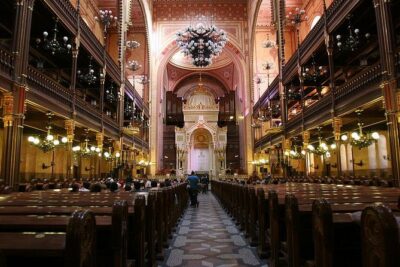
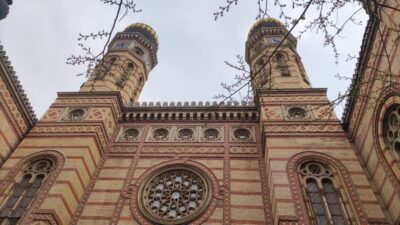
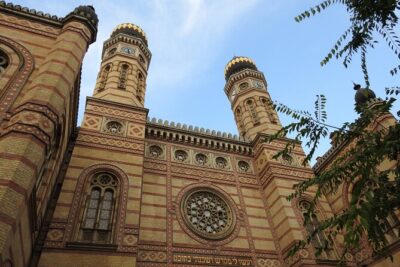
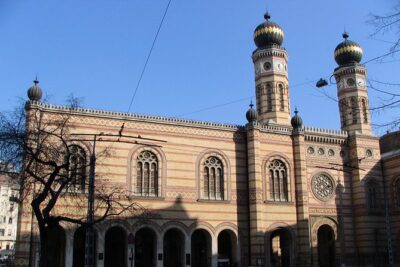
The Great, or Central, Synagogue is the route’s key historical landmark. It is described as the largest synagogue in Europe and serves as the main point for learning about Budapest’s Jewish community.
The tour gives you about five minutes at this stop. That is enough for an exterior look and a concise explanation, but not a full visit. Admission is listed as free for the stop, yet the experience does not include a synagogue entry ticket or an interior tour. If you want to go inside, you will need to arrange that separately.
This distinction is important when judging the $14.47 price. You are paying for a guided audio route and the convenience of a planned walk, not for attraction admissions. The price is fair if you want context and independence. It is less useful if you expect a detailed religious, architectural, or memorial tour.
I would give this stop extra attention. The synagogue is not just another photo stop. It anchors the story of the neighborhood and helps you understand why the surrounding streets carry such a distinct identity.
Ending at Szimpla Kert, Budapest’s famous ruin bar
The route ends at Szimpla Kert on Kazinczy Street 14. Szimpla is described as one of the first ruin bars in Budapest and the model for many that followed.
This is a smart ending. After the avenue, Opera, Jewish quarter, passage, and synagogue, you finish in a place that represents the area’s current social character. The bar’s presence also helps explain why the old Jewish quarter is now called a festive district.
The tour introduces Szimpla Kert but does not include a drink, meal, or reserved place. You can finish the walk there and decide for yourself if you want to stay. That gives you useful flexibility. Some people will want a quiet end to the afternoon, while others will be ready to see what the ruin-bar scene is about.
The final address is Budapest, Kazinczy u. 14-1075, 1075 Hungary. Check your phone before setting out so you can recognize the ending point and avoid confusing the final stop with a separate bar reservation.
What the audio format does well
The Rewind app is built to trigger stories automatically as you reach the route’s points. You are not required to meet a guide, find a group flag, or arrive at a fixed departure time. That makes the walk especially practical for a private group.
I also like the use of professional guides and actors for the recordings. The format is designed to sound more like a prepared tour than a dry set of written notes. One person found the guide easy to listen to, and another was able to use the tour on an iPhone during rainy weather while walking at a comfortable pace.
Rain, in fact, is one of the situations where this format makes sense. You can start when conditions suit you and stop if you need shelter. The route still depends on being outdoors, so waterproof shoes and a charged phone are sensible choices.
The major risk is technical. One booking could not be linked to the app, even after messages were sent five days, three days, and twice the day before. The responses were automatic, which did not solve the problem. I would download or open the app well before your planned start, connect the booking, and contact support early if anything fails.
Is $14.47 a fair price?
At $14.47 per person, this is inexpensive compared with a private live walking tour. You receive a planned route, recorded commentary, and the freedom to begin at a time that works for you. For a couple or small private group, the cost can make sense.
The value depends on what you want from Budapest. If you need a quick introduction to Andrassy Avenue, the Opera, the old Jewish quarter, the Great Synagogue, Gozsdu Passage, and Szimpla Kert, the price is reasonable.
If you want long explanations, inside visits, personal questions answered, or a detailed account of Jewish Budapest, I would spend more on a live specialist guide. The five-minute stops are helpful signposts, not full lessons.
The rating is 4 out of 5 from five published ratings, so I would not treat the score as a large statistical verdict. The strongest praise centers on the route’s information, easy pacing, and usefulness in bad weather. The main caution concerns app setup and customer service.
Who should choose this Budapest walk?
I would recommend it to:
- First-time visitors who want a structured introduction to central Budapest.
- Couples, families, or friends who prefer a private walk without a group schedule.
- Independent visitors who like listening at their own pace.
- People with a free afternoon who want to connect major sights with the Jewish quarter.
- Anyone curious about ruin bars but also interested in the area’s older identity.
I would be more cautious if you dislike using your phone while walking. The smartphone is your only guide, so the experience depends on the Rewind app and your device. I would also choose another option if you want a specialist discussion of Jewish history or a guided visit inside the synagogue.
Service animals are allowed, and the route is near public transportation. Most people can participate. The activity is private, meaning only your own group takes part, which is a useful benefit if you prefer not to walk with strangers.
Practical timing and cancellation advice
The route is available daily during the listed period, from 12:00 AM to 11:30 PM. Since the stated duration is about 90 minutes, I would begin with enough daylight if you want to examine the buildings clearly, though the late schedule gives you the option of an evening walk toward Szimpla Kert.
Confirmation is provided when you book. I would check that the booking appears correctly in the app before leaving your accommodation. Keep your phone charged and make sure you know both the starting address at Vörösmarty Street and the ending address on Kazinczy Street.
Free cancellation is available up to 24 hours before the start time for a full refund. Inside that 24-hour window, you cannot receive a refund, and changes are not accepted. The cut-off follows Budapest local time, so do not wait until the last minute if your plans are uncertain.
Should you book it?
Book this walk if you want a low-cost, flexible way to connect Budapest’s grand avenue with its old Jewish quarter. I especially like the route’s finish at Szimpla Kert, the useful mix of architecture and local culture, and the freedom to walk privately in your own group.
Go in with the right expectations. You are buying an audio introduction, not attraction entry, a food tour, or a long live lecture. Set up the app early, allow extra time for the Great Synagogue or House of Terror if you plan to visit inside, and choose this experience for independence rather than personal conversation.
FAQ
How long does the Budapest Festive and Old Jewish District tour take?
The tour takes approximately 1 hour and 30 minutes.
What is the price of the tour?
The price is $14.47 per person.
Where does the walking tour begin?
It begins at Budapest, Vörösmarty u. 37, 1064 Hungary, near the House of Terror Museum.
Where does the tour end?
The route ends at Budapest, Kazinczy u. 14-1075, 1075 Hungary, near Szimpla Kert.
Is admission to the House of Terror Museum included?
No. Admission to the House of Terror Museum is not included.
Does the tour include entry to the Great Synagogue?
The tour includes a stop at the Great Synagogue, but no entry ticket or interior visit is listed as included.
Can I cancel for a full refund?
Yes. You can cancel at least 24 hours before the experience start time for a full refund. Cancellations within 24 hours are not refunded.
Just added around Budapest
- Lake Balaton and Herend Guided Tour★ 4.7 · 3 reviews
- Audio visual multi-sensory chefs journey dinner experience★ 5.0 · 3 reviews
- Hollókő Ethnographic Village: Day Tour from Budapest★ 3.7 · 3 reviews
- Tapolca Cave Lake and Tihany/ Balaton private tour from Budapest★ 4.5 · 3 reviews
- Budapest Art Nouveau Walking Tour★ 5.0 · 3 reviews
- SzentEndre-SaintAndrew City Privately Shopping and Picturesque★ 4.5 · 3 reviews
- Budapest Drinks and Piano Show Cruise★ 4.5 · 3 reviews
- Horseshow on the Hungarian Puszta, private tour from Budapest with entry!★ 5.0 · 3 reviews
Jewish Quarter Tours, compared.
Budapest Jewish Heritage Memorial Walking Tour & Synagogue Entry
What we thought →
Jewish Heritage Guided Tour with Synagogue Ticket
What we thought →
Past and Present of Budapest Jewish District Tour
What we thought →
Budapest Dohany Synagogue & Hungarian Jewish Museum & free extras
What we thought →
Jewish History Guided Walking Tour with Historian
What we thought →Browse the lists this tour appears in