Reviewed · PRIVATE
Rise Against the Soviet: The 1956 Revolution – Private Tour
Revolution leaves marks. Budapest’s 1956 uprising is best understood on the streets where it happened, and this private tour links Parliament, protest squares, radio headquarters, and the Corvin resistance district. I like the personal accounts of Communist-era life and the way the route connects the revolt to Hungary’s earlier struggles. The main drawback is time: three hours can feel short for such a large subject.
I also like the private format. Your guide can adjust the pace, answer your questions, and spend more time on the parts that matter to you. The route uses walking and public transportation, and the group price of $228.66 for up to five people can be fair if you are sharing it with family or friends. Solo visitors may find it harder to justify.
In This Review
- Key points to know before booking
- Why Budapest’s 1956 Revolution still matters
- Starting at Parliament on Kossuth Lajos Square
- Imre Nagy and the old Communist headquarters near Margaret Bridge
- Bem Square, student protest, and Bambi Eszpresszó
- Sándor Petőfi’s statue and the language of revolt
- Radio Budapest, the call for help, and the fighting
- Corvin Square and the young resistance
- What the private format adds
- Is $228.66 good value?
- Who should book it?
- Final verdict: a strong choice for the right history-minded visitor
- FAQ
- How long does the tour last?
- What is the price?
- Is the tour private?
- Is hotel pickup available?
- What language is offered?
- Are public transportation tickets included?
- Is food or drink included?
- Are entrance tickets required for the listed stops?
- What is included in the tour?
- Can I cancel for a full refund?
Key points to know before booking
- Kossuth Square sets the scene: Learn where a 1956 demonstration ended in a government massacre, beside the Hungarian Parliament.
- The route follows real protest ground: Bem Square, the Petőfi statue, Radio Budapest, and Corvin Square all played distinct roles in the revolt.
- Personal stories add weight: Guides including Miklós and Peter have offered personal insight into life before and after 1956.
- You will use Budapest’s transport network: Expect a mix of walking and public transportation, with transport tickets not included.
- Bambi Eszpresszó adds everyday context: This long-running café helps show the social world around Buda’s intellectuals.
- The subject receives a wider frame: The tour links 1956 with the 1848 revolution, Polish unrest, and the fall of Communism in 1990.
Why Budapest’s 1956 Revolution still matters
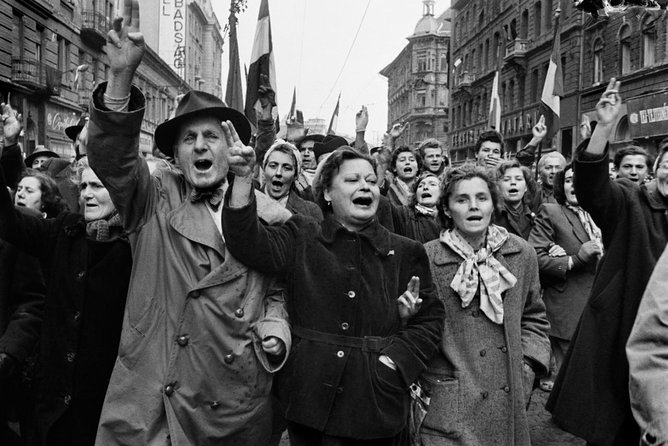
The Hungarian Revolution of 1956 lasted only a few weeks, but it changed how the outside world viewed Soviet control in Eastern Europe. Students, workers, writers, and ordinary residents challenged the Communist government and demanded political freedom, national independence, and the withdrawal of Soviet forces.
The revolt was crushed by a Soviet invasion. Many people were killed, imprisoned, or forced into exile. Prime Minister Imre Nagy was later executed, despite having become a symbol of Hungary’s attempt to choose its own path.
This tour works best because it does not treat November 1956 as an isolated event. You get links to the 1848 revolution, when Hungarians also fought imperial rule, and to the 1990 end of Communist government. That wider timeline helps you understand why certain statues, squares, and poems still matter in Budapest.
I would choose this experience if you want more than dates and military facts. The strongest guiding seems to come from the human side: what daily life felt like, how people heard the news, and how the revolt affected families for decades. One guide, Miklós, lived through the Communist era and has been praised for bringing that period into clear personal focus. Peter has also been described as especially good at answering questions and adjusting the pace for an older family member.
A few more trips worth weighing up before you book
- Private Budapest TukTuk Tour: Custom Route, Hotel Pickup
★ 5.0 · 1,307 reviews - Budapest Essentials Private Tour Highlights and Hidden Gems
★ 5.0 · 861 reviews - Budapest Private Tuk Tuk Half-Day Tour
★ 5.0 · 606 reviews
Starting at Parliament on Kossuth Lajos Square
The tour begins at Kossuth Lajos Square, one of Budapest’s grandest civic spaces. The Hungarian Parliament dominates the square, but the focus here is not only architecture. You will learn about the mass demonstration in October 1956 and the shooting that killed dozens of people.
This is a powerful opening because the square makes the conflict easy to picture. A public gathering took place in front of the government’s most important building. The crowd wanted change, yet the state answered with violence. The physical setting turns an abstract political crisis into a specific place where people gathered, hoped, and died.
Allow about 25 minutes here. There is no admission charge for the stop, but the value comes from the explanation rather than an indoor display. Ask your guide how the demonstration fitted into the first days of the uprising. You can also ask about what happened to the government after the shooting.
The square is a good place to begin, though it may feel familiar if you have already taken a standard Parliament tour. This experience is not centered on entering the Parliament building. Its purpose is to read the square as a political stage.
Imre Nagy and the old Communist headquarters near Margaret Bridge
The next stop moves toward Margaret Bridge and the Danube. Here you will see a building once known as the White House, the former headquarters of Hungary’s Communist Party government.
The location gives you a useful change of viewpoint. At Parliament, you are looking at the formal seat of government. Near Margaret Bridge, you are looking at the machinery of the ruling party. The contrast helps explain why the revolution was not simply a street protest. It challenged an entire system of power.
The nearby statue of Imre Nagy adds a personal face to the story. Nagy served as prime minister during the 1956 crisis and became associated with Hungary’s effort to break away from Soviet control. He was later executed, making the statue a place of remembrance as well as politics.
This stop lasts about 20 minutes. It is short, so do not expect a full biography of Nagy. Instead, use the time to ask about his changing position during the uprising and why his fate remained so important after 1956.
Bem Square, student protest, and Bambi Eszpresszó
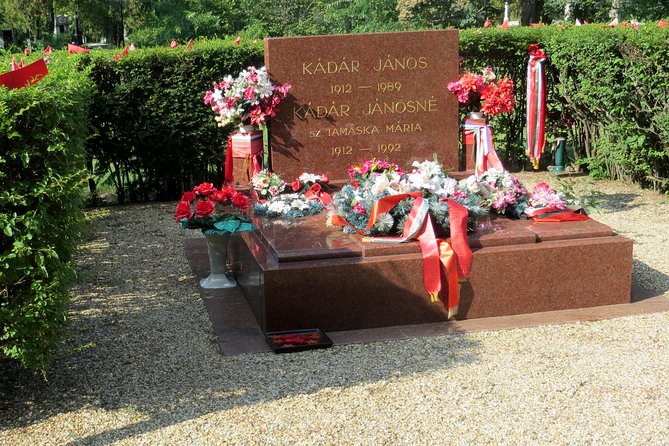
Bem József Memorial Square is one of the most important stops on the route. In 1956, roughly 200,000 Hungarian students gathered here in a demonstration that began as an expression of support for Polish workers.
That detail matters. The uprising did not appear from nowhere, and it was not confined to Budapest. Events in Poland helped spark Hungarian action. Students used the gathering to express demands against Soviet rule and the Hungarian Communist government.
The square also gives your guide room to discuss the role of young people, writers, and intellectuals. The movement drew support from many parts of society, and this gathering showed its size early in the revolt.
The planned visit to Bambi Eszpresszó adds an unusual everyday layer. The café has operated since the 1960s and kept the same interior and atmosphere. It became a meeting place for Buda-side intellectuals, offering a glimpse of social life under Communism.
Food and drinks are not included, so any café purchase is extra. Still, I think this is one of the tour’s more useful touches. A café cannot explain the revolution by itself, but it can help you imagine where people talked, argued, and tried to make sense of political change. The stop takes about 30 minutes.
A completely different kind of day out around Budapest:
- Budapest: City Highlights Cruise with Welcome Drink
★ 4.6 · 35,610 reviews - Budapest: Unlimited Prosecco, Beer and Aperol Spritz Cruise
★ 4.8 · 25,310 reviews - Budapest: Széchenyi Spa Day Ticket with Optional Upgrades
★ 4.3 · 23,911 reviews - Budapest: Nighttime or Daytime Sightseeing Cruise
★ 4.2 · 21,062 reviews
Sándor Petőfi’s statue and the language of revolt
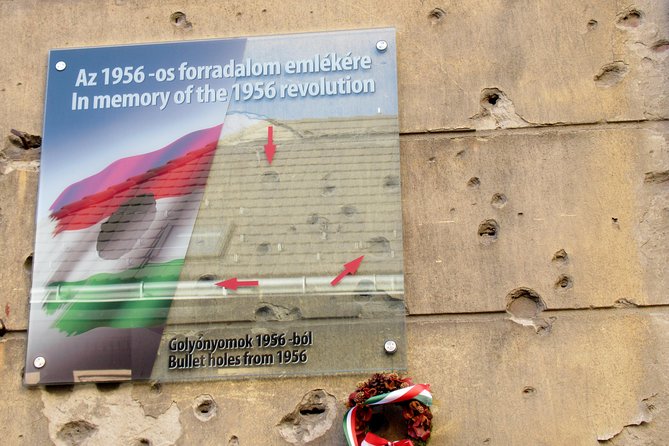
At the statue of Sándor Petőfi, the tour reaches back to the 1848 revolution. Petőfi was a poet and a major figure in Hungary’s earlier struggle against government authority. By 1956, his name and words had come to represent resistance more broadly.
The statue remains a meeting point for political events and protests. That continuing role gives the stop more meaning than a simple literary reference.
In 1956, actor Sinkovits Imre came to the statue and recited Petőfi’s revolutionary words. He was later arrested and imprisoned. This small story shows how culture and politics met during the uprising. A poem could become an act of defiance, and a public performance could bring serious consequences.
You will spend about 15 minutes here. It is the shortest stop, so the guide will need to keep the explanation focused. If you care about literature, ask for more detail about Petőfi and the 1848 connection. If your main interest is military history, this stop may feel less central, but it explains the symbols protesters used.
Radio Budapest, the call for help, and the fighting
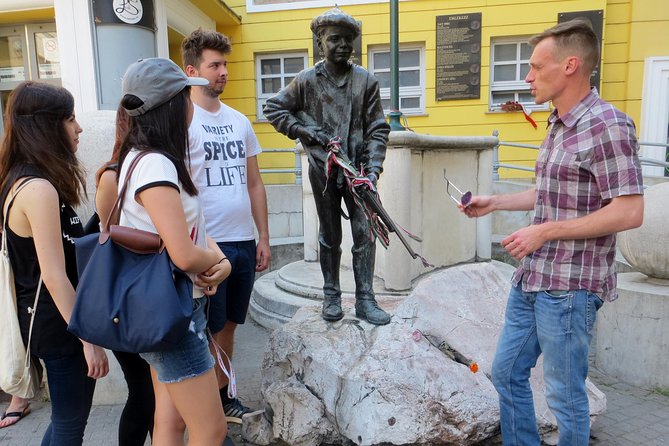
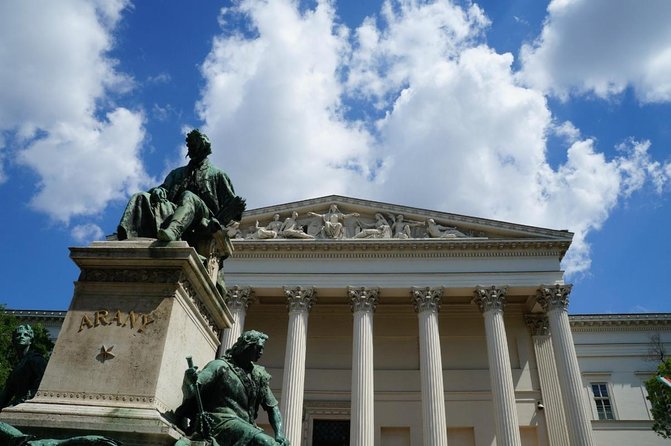
The route then reaches the Magyar Rádió building, also known as Radio Budapest. It sits along narrow, one-way Sándor Bródy Street, near the Hungarian National Museum area.
The building became one of the main centers of fighting in 1956. Revolutionaries tried to use the radio to broadcast their demands and appeal to the outside world for help. That makes this more than another political building. Radio was the link between events inside Hungary and listeners beyond its borders.
The stop is scheduled for about 20 minutes. You will view the building from the street and hear how it fitted into the conflict. The setting can be easy to miss if you are exploring alone, since it is away from the city’s main thoroughfares.
One point worth clarifying is that the route refers to the Hungarian National Museum area, but the historical focus here is the Radio Budapest building. If you expect a museum visit or an indoor collection about 1956, ask your guide before the tour begins. The experience described here is a street-based visit, not an included museum admission.
Corvin Square and the young resistance
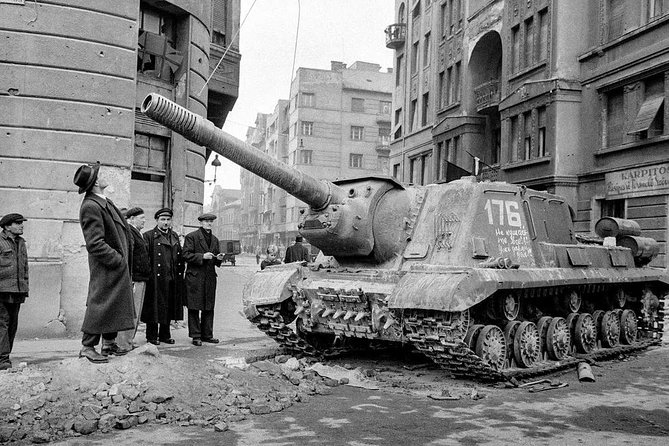
The final major stop is Corvin Square, or Corvin köz, in southeastern Budapest. During the Soviet invasion, this became one of the key resistance centers.
Local young people fought Soviet troops with guns taken from soldiers and Molotov cocktails used against tanks. The story is grim, but it also explains why Corvin has such a strong place in Hungarian memory. The resistance was not led only by senior politicians. Young residents took enormous risks in the streets around their homes.
You will spend about 30 minutes here, discussing the fighting, the Soviet invasion, and what followed. The guide can point out reminders of the battles and explain why this district became a center of resistance.
This is likely the most dramatic outdoor stop, but it is also where the short duration becomes most noticeable. The military events, civilian suffering, reprisals, imprisonment, and emigration could fill an entire day. One guide acknowledged that the subject could have continued for hours, and another visitor felt the tour gave too little time to the revolution itself.
That criticism is worth taking seriously. The route covers important places, but it cannot cover every major site in three hours. If you already know the basic story of 1956, you may want to tell the guide exactly which locations or episodes you want to prioritize.
What the private format adds
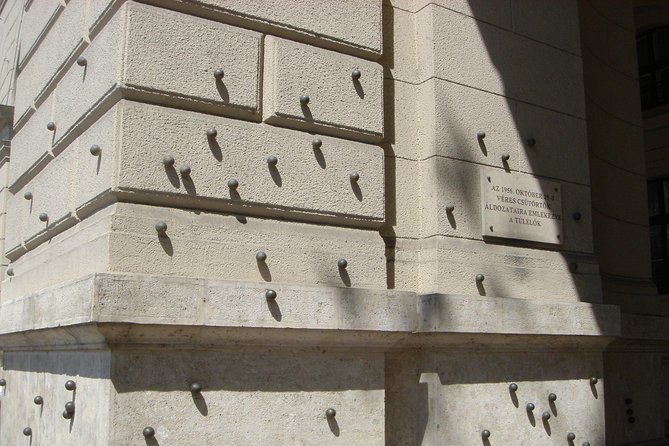
A private tour means only your group participates. The price covers up to five people, so the value improves quickly when shared by a couple, family, or small group of friends.
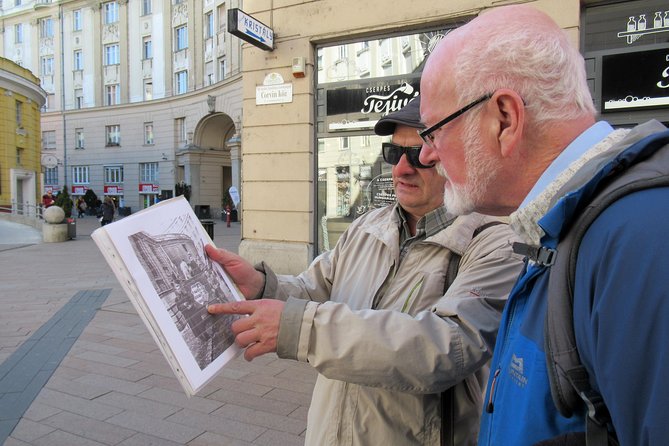
The main benefit is flexibility. A good guide can slow down for an older family member, as Peter did for a 91-year-old man whose family history was tied directly to the 1956 escape from Hungary. A private guide can also spend more time on personal stories, political context, or military details according to your interests.
The quality depends heavily on the individual guide. Miklós and Peter received especially warm praise for their clear explanations and personal insight. One visitor, however, felt the tour was too general and noted that the guide was taking the route for the first time. That is a useful warning: the experience can be excellent, but the depth may vary.
The route also includes walking and public transportation. Tickets and passes are not included, and food and drinks are extra. Since pickup is offered from your Budapest hotel or a central meeting point, confirm the exact start location and allow room in your plans for transport between stops.
Is $228.66 good value?
At $228.66 per group, the price is not cheap for a three-hour activity. Split five ways, it becomes about $45.73 per person. For two people, it is about $114.33 each. A solo visitor pays the full group rate unless the provider offers another arrangement.
The strongest value comes from the guide, not from admissions. Every listed stop has free entry, so you are paying for research, transport planning, interpretation, local context, and the chance to ask questions throughout.
I would call it good value for a small group with a serious interest in Hungarian history. It is less attractive if you want a low-cost sightseeing walk or a museum-heavy experience. The included handouts and Communist-era souvenir are pleasant extras, but they should not drive your decision.
The rating is 4.7 from 11 ratings, with 91 percent recommending the experience. That is encouraging, though the sample is small. The pattern is clear: the highest praise centers on personal insight, clear storytelling, and the mix of walking with tram rides or other public transport. The main negative point is not poor service. It is that the subject can feel rushed or too broad.
Who should book it?
I would recommend this tour to:
- People who want to understand Hungary’s Communist period through real locations.
- History fans interested in the 1956 Revolution, the Soviet Union, and Eastern European politics.
- Families who want a private pace for an older relative.
- Visitors who prefer conversation and local interpretation over a fixed audio guide.
- Small groups willing to use public transportation between stops.
I would be more cautious if you want extensive time inside museums, a highly specialized military study, or a leisurely walk with no transport. The tour is also not a complete survey of every 1956 site in Budapest.
You should have a moderate level of physical fitness because the experience combines walking with public transportation. Service animals are allowed, and the route is near public transport. Pickup is available from your hotel or a central location agreed with the provider.
Final verdict: a strong choice for the right history-minded visitor
Book this private tour if you want the 1956 Revolution explained through Budapest’s streets, statues, cafés, and former government buildings. I especially value the links between 1848, 1956, and 1990, along with the chance to hear about daily life under Communism from guides with personal experience of the era.
Do not book it expecting a complete study of the uprising in three hours. The route is a thoughtful introduction, not a full course. To get the most from it, tell your guide before starting that the revolution itself is your priority, then ask to give extra time to the sites that interest you most.
FAQ
How long does the tour last?
The tour lasts approximately three hours.
What is the price?
The price is $228.66 per group for up to five people.
Is the tour private?
Yes. Only your group participates in the activity.
Is hotel pickup available?
Yes. You can meet the guide at your Budapest hotel or at a central point agreed with the provider.
What language is offered?
The tour is offered in English.
Are public transportation tickets included?
No. Public transportation tickets or passes are not included.
Is food or drink included?
No. Other drinks and food are not included.
Are entrance tickets required for the listed stops?
The listed stops show free admission. The tour focuses on outdoor locations and does not include a paid museum admission.
What is included in the tour?
Handouts and a Communism-related souvenir are included.
Can I cancel for a full refund?
Yes. You can cancel at least 24 hours before the local start time for a full refund. Changes or cancellations made less than 24 hours before the start time are not accepted for a refund.
Just added around Budapest
- Lake Balaton and Herend Guided Tour★ 4.7 · 3 reviews
- Audio visual multi-sensory chefs journey dinner experience★ 5.0 · 3 reviews
- Hollókő Ethnographic Village: Day Tour from Budapest★ 3.7 · 3 reviews
- Tapolca Cave Lake and Tihany/ Balaton private tour from Budapest★ 4.5 · 3 reviews
- Budapest Art Nouveau Walking Tour★ 5.0 · 3 reviews
- SzentEndre-SaintAndrew City Privately Shopping and Picturesque★ 4.5 · 3 reviews
- Budapest Drinks and Piano Show Cruise★ 4.5 · 3 reviews
- Horseshow on the Hungarian Puszta, private tour from Budapest with entry!★ 5.0 · 3 reviews
Private, compared.
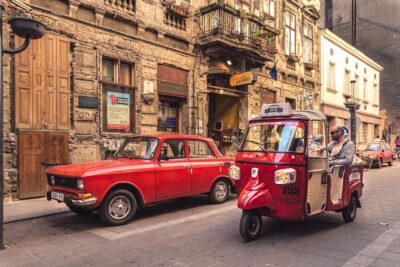
Private Budapest TukTuk Tour: Custom Route, Hotel Pickup
What we thought →
Budapest Essentials Private Tour Highlights and Hidden Gems
What we thought →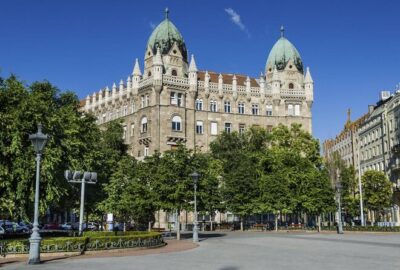
Budapest One Way Private Transfer to or from Airport
What we thought →
Budapest Private Luxury Sightseeing Tour with Guide and Transport
What we thought →
Private Budapest City tour with Classic Russian Jeep or G-Wagon!
What we thought →
Budapest Private Full Day City Sightseeing Tour Walking or by Car
What we thought →