
Reviewed · BUDAPEST
Pest side stories with a Historian
Budapest’s Pest side rewards curious walkers. This three-hour tour links major sights with the stories behind them, from former market squares and royal-looking buildings to the city’s oldest underground railway. I especially like the small group capped at 10 and the way the guides connect buildings, statues, wars, and Hungarian identity. The main drawback is simple: you cover a lot of ground, so this is not a gentle sightseeing stroll.
The historian-led storytelling gives the route purpose, while included refreshments and metro tickets add practical value to the $58.94 price. Guides including Andrew, Greg, Steven, and others have been praised for keeping an easy pace and explaining Budapest clearly, but hot weather or tired feet could make the three hours feel long.
In This Review
- Key points to know before booking
- Why this Pest tour is different
- Starting at Elizabeth Square at 2:00 pm
- St. Stephen’s Basilica and the choice to go inside
- Heroes’ Square: Budapest history in one broad view
- Vajdahunyad Castle, a medieval-looking building from 1896
- Andrassy Avenue and the pride of Pest
- Vorosmarty Square and the commercial heart of Pest
- Riding the Millennium Underground
- What the historian guides add
- Walking effort, weather, and timing
- Is $58.94 a fair price?
- Who should book this Pest walk?
- FAQ
- Where does the Pest side tour begin?
- Where does the tour finish?
- How long does the tour last?
- How large is the group?
- Are metro tickets included?
- Can I cancel for a full refund?
- Should you book this tour?
Key points to know before booking
- A wide Pest route in three hours: You visit Elizabeth Square, St. Stephen’s Basilica, Heroes’ Square, Vajdahunyad Castle, Andrassy Avenue, Vorosmarty Square, and the Millennium Underground.
- Small groups make the history personal: The maximum group size is 10, a useful contrast to large bus tours.
- The route covers more than postcard sights: Guides explain former political uses, invading powers, wars, commerce, finance, and the beliefs shown in statues and building decoration.
- The Millennium Underground adds a real Budapest experience: Metro tickets are included, and the route uses Europe’s oldest underground railway.
- Walking matters: The tour covers a large part of central Pest, with around 30 minutes set aside at several stops.
- The afternoon start is convenient: Meet at 2:00 pm outside the Kempinski Hotel Corvinus Budapest on Elizabeth Square.
Why this Pest tour is different
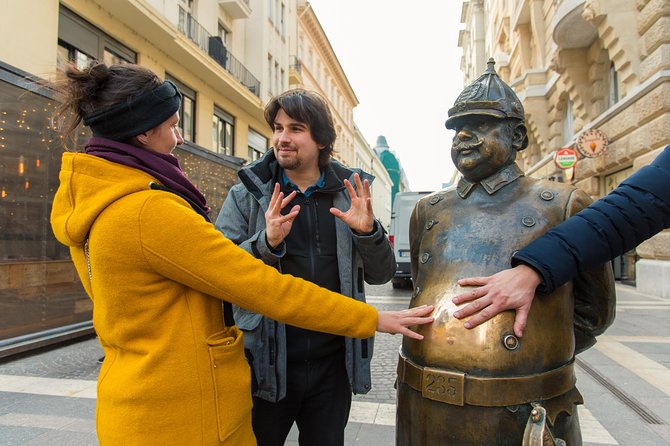
Many city walks give you a string of photo stops and a few dates. This one tries to explain how Pest changed over time. That matters in Budapest, where a square may have been a market, a Stalin-era public space, a bus station, and later a meeting place for younger crowds.
The route also gives you a useful mix of famous and less obvious places. Heroes’ Square and St. Stephen’s Basilica are essential Budapest sights, but Vajdahunyad Castle often receives less attention. The tour uses these places to tell a wider story rather than treating each one as an isolated monument.
I like that the historical angle is not limited to medieval kings. The guides also discuss the impact of invading powers and the wars of the previous century. They point to statues, decoration, financial buildings, and the former grain exchange to show how politics and economics shaped the city.
The format helps. With no more than 10 people, you are more likely to hear the guide, ask questions, and keep the group together across busy central streets. It also avoids the feel of a large coach tour, an important point if you prefer walking and conversation to a microphone and a crowd.
Other Budapest days people book alongside this one:
- Budapest: City Highlights Cruise with Welcome Drink
★ 4.6 · 35,610 reviews - Budapest: Unlimited Prosecco, Beer and Aperol Spritz Cruise
★ 4.8 · 25,310 reviews - Budapest: Széchenyi Spa Day Ticket with Optional Upgrades
★ 4.3 · 23,911 reviews
Starting at Elizabeth Square at 2:00 pm
The tour begins at the Kempinski Hotel Corvinus Budapest, at Erzsébet tér 7-8. Elizabeth Square itself is a useful opening chapter because its past is unusually varied. It served as a market square, later carried the name Stalin Square, and was also used as a bus station.
Today, it is known as a young party area, with statues and other points of interest around the square. That change gives your guide a chance to show that city history is not only about old churches and grand palaces. Public spaces get renamed, rebuilt, and used in new ways as governments and social habits change.
Allow yourself a few minutes to find the meeting point. The start is central, near public transportation, but a central Budapest square can have several nearby entrances and busy pedestrian areas. The listed start time is 2:00 pm.
This first stop lasts about 20 minutes. It is short enough to keep the tour moving, but long enough to establish the main idea: Pest is a city of layers.
St. Stephen’s Basilica and the choice to go inside
St. Stephen’s Basilica is described as the largest church in Budapest and is one of the city’s major landmarks. The exterior and surrounding square offer an early look at the scale of Pest’s religious and civic architecture.
The plan allows around 20 minutes here. If the group is interested, the guide may take you inside. That wording is important. Interior entry is not presented as a guaranteed part of every tour, so you should book this experience for the guided walk and outdoor sightseeing rather than assume you will receive a full basilica visit.
This flexible approach can work well for a small group. If the group wants to see the interior, there is room for that preference. If not, the guide can keep the route moving. Still, if entering the basilica is a priority for you, ask the provider before booking.
The tour ends at St. Stephen’s Basilica according to the standard plan, although it may finish at another central Pest location near the starting point. That makes the basilica a useful place to continue sightseeing after the walk, but the exact final location can vary.
Heroes’ Square: Budapest history in one broad view
Heroes’ Square receives about 30 minutes, and that is time well spent. The square is presented as a place to begin understanding more than 1,100 years of Hungarian history.
You will not absorb every chapter of that history in half an hour. The value lies in having a guide explain the figures, symbols, and political ideas represented by the monument. This is one of the places where a historian’s approach can make a real difference. A quick photo tells you what the square looks like. A good explanation helps you understand why it was built and what message it was intended to send.
The scale of Heroes’ Square also changes the rhythm of the tour. After central streets and smaller urban spaces, you get a broad ceremonial setting. The guide can connect the square’s public imagery with the struggles and ambitions of the Hungarian people, themes that appear again in Budapest’s statues and building decoration.
This stop is one of the strongest reasons to choose the tour if you want context rather than only a checklist of sights. It also helps you read later monuments with more attention.
A completely different kind of day out around Budapest:
- Budapest: Nighttime or Daytime Sightseeing Cruise
★ 4.2 · 21,062 reviews - Budapest: 1-Hour Evening Sightseeing Cruise with Drink
★ 4.5 · 8,330 reviews - Budapest Danube Cruise and Dinner Options, Live Music and Dance
★ 4.5 · 7,428 reviews - Budapest: Historic Cruise with Welcome Drink
★ 4.7 · 6,512 reviews
Vajdahunyad Castle, a medieval-looking building from 1896
Vajdahunyad Castle is one of the most interesting stops because its appearance can fool you. It looks medieval, but the castle was built in 1896.
That date is the key to the visit. The guide explains why and how a medieval-looking complex was created at that time. You get a practical lesson in how cities use historical styles to express national pride and connect the present with an idealized past.
The stop lasts about 30 minutes. Compared with the more famous central sights, it is described as less visited, which can make it a welcome change of pace. You are not simply following the most crowded route through Budapest. You are seeing a place with a clear visual puzzle and hearing the explanation behind it.
The castle also gives the guide another chance to discuss the relationship between architecture and national identity. Look closely at the design rather than treating it as a single old building. Its medieval appearance is part of the story, not proof of its age.
Andrassy Avenue and the pride of Pest
Around 30 minutes are set aside for Andrassy Avenue, described as a source of pride for Budapest residents and a UNESCO World Heritage Site since 2002.
The avenue helps tie the separate stops together. It is not just a road between Heroes’ Square and central Pest. It represents the city’s grand urban ambitions and gives you a sense of how Budapest presents itself through long views, important buildings, and planned public spaces.
This is also where the walking requirement becomes clear. The tour does not linger in one compact neighborhood. It uses the distance between sights as part of the experience. That is useful if you want an overview on your first day, but it means you should wear comfortable shoes and be ready to keep moving.
One guide, Andrew, was praised for covering a large area while keeping the pace easy. That is the balance you want on this route. You see a great deal, but the walk should not become a race.
Vorosmarty Square and the commercial heart of Pest
Vorosmarty Square is allotted about 15 minutes. It is an iconic central square with a strong commercial character, including high-end products in the heart of historic Pest.
This stop adds an economic side to the tour. Budapest is not only churches, monuments, and political memories. Its central squares also show how commerce shapes the visitor experience and the city’s public identity.
The shorter time here makes sense. The square is central and easy to revisit on your own, so the guide can focus on its role and then continue. You can make a note of the location if you want to return later for shopping or another look at the surrounding streets.
A guide can also connect this area with the financial buildings and former grain exchange discussed along the route. Those details help you see Pest as a working commercial center, not merely a historic display.
Riding the Millennium Underground
The Millennium Underground receives about 30 minutes and is identified as the oldest underground railway on the European continent. Metro tickets are included, so you do not need to arrange that part separately.
This is a valuable inclusion because it turns transportation into a sight. Instead of simply walking past another station, you learn why this particular underground line matters to Budapest and to the development of urban travel.
The underground section also breaks up the walking. The route still covers a large area, but the metro ride gives your feet a short change of pace and reinforces the tour’s focus on how the city developed.
Since the itinerary includes both street-level landmarks and public transportation, you get a more complete picture of Pest. The city’s history is visible in squares and monuments, but also in the systems built to move people through it.
What the historian guides add
The provider uses several guides, including Steven, Andrew, Greg, and others. Their style appears to vary by personality, but the strongest common feature is detailed explanation delivered at an easy pace.
Steven was praised for leading a wide-ranging route through the waterfront and downtown area while discussing the basilica, financial buildings, the former grain exchange, invading powers, and twentieth-century wars. That gives you an idea of the tour’s scope. It is not a narrow architecture walk.
Andrew was noted for explaining the history of the region and cities in detail without forcing the group into a hard pace. Greg led an afternoon walk around Pest that focused on interaction as well as information. Another guide was described as kind and full of stories about Hungarian people and their history across the centuries.
These details point to a tour that works best when you enjoy asking questions. You are not only being shown where to stand for a photograph. You are encouraged to connect places with the people, conflicts, and ideas behind them.
The small group is important here. A maximum of 10 people gives the historian room to respond to the group’s interests. It also makes the tour feel less like a fixed performance.
Walking effort, weather, and timing
The advertised duration is about three hours. That sounds manageable, and it is, but the route covers a large part of Pest. Several stops take 30 minutes, and the walk between them adds to the physical demand.
One account specifically described a hot day with long distances, while still finding that the group saw everything at an acceptable pace. Take that as useful planning advice. In warm weather, carry water, use sun protection, and do not schedule a demanding activity immediately afterward.
The 2:00 pm start can work well if you want a morning for independent sightseeing. It also means part of the walk may take place during the warmer part of the day. The tour includes refreshments, but the details of what is provided are not specified, so bring anything else you personally need.
Most people can participate, and service animals are allowed. The activity is near public transportation, with metro tickets provided. No special physical ability is stated, but the amount of walking should guide your decision.
Is $58.94 a fair price?
At $58.94 per person, this is not the cheapest way to see Pest. You can walk through several of these areas independently without paying an admission fee. The question is what you want your money to buy.
Here, the price includes a historian guide, refreshments, and metro tickets. The group is limited to 10 people, and the route covers a wide area in about three hours. You are paying for organization, interpretation, and the chance to ask questions without being lost in a large crowd.
The value is strongest if you are new to Budapest or want a historical framework early in your visit. After the tour, places such as Heroes’ Square, Andrassy Avenue, and Vajdahunyad Castle should make more sense. You can then return to the sights that interested you most.
The value is weaker if you prefer a slow walk with plenty of free time at each stop. This is a packed route, and the basilica interior is optional rather than assured. You are also paying for a broad overview, not a specialist tour focused on one building or period.
The experience has a 4.9 rating from 14 ratings, with 100 percent recommending it. That is a small sample, but it matches the main strengths: strong guides, detailed history, a manageable group, and a lot of ground covered.
Who should book this Pest walk?
I would choose this tour if you want to understand Budapest’s Pest side in one afternoon. It suits first-time visitors, history-minded couples, and anyone who prefers a small walking group to a bus tour.
It is also a good choice if you want a guide who can explain more than royal dates. The route touches politics, national identity, religion, commerce, public art, transportation, and the effects of war. That range gives you a useful first look at the city.
You may want another option if your priorities are shopping, long café breaks, or extended time inside St. Stephen’s Basilica. The tour’s strength is breadth, and breadth requires walking and steady movement.
Free cancellation is available when you cancel at least 24 hours before the 2:00 pm start. Changes or cancellations inside that window are not accepted for a refund.
FAQ
Where does the Pest side tour begin?
It begins at the Kempinski Hotel Corvinus Budapest, Erzsébet tér 7-8, at 2:00 pm.
Where does the tour finish?
The standard end point is St. Stephen’s Basilica. It may also finish at another central Pest location close to the starting point.
How long does the tour last?
The tour lasts approximately three hours.
How large is the group?
The maximum group size is 10 people.
Are metro tickets included?
Yes. Metro tickets are provided, including for the Millennium Underground portion of the route.
Can I cancel for a full refund?
Yes, if you cancel at least 24 hours before the experience start time. Cancellations or changes made less than 24 hours before the start are not refunded.
Should you book this tour?
Book it if you want a wide-ranging, historian-led introduction to Pest and do not mind walking. The route covers major sights, a less visited castle, a UNESCO avenue, commercial squares, and the Millennium Underground, all within a small group.
I would especially recommend it early in a Budapest visit, when the city’s symbols and political layers may otherwise seem hard to read. Skip it if you want a slow, highly focused tour or guaranteed basilica entry. For most curious visitors who value explanation over simple sightseeing, the $58.94 fee is reasonable for the amount of ground, context, and personal guidance included.
Just added around Budapest
- Lake Balaton and Herend Guided Tour★ 4.7 · 3 reviews
- Audio visual multi-sensory chefs journey dinner experience★ 5.0 · 3 reviews
- Hollókő Ethnographic Village: Day Tour from Budapest★ 3.7 · 3 reviews
- Tapolca Cave Lake and Tihany/ Balaton private tour from Budapest★ 4.5 · 3 reviews
- Budapest Art Nouveau Walking Tour★ 5.0 · 3 reviews
- SzentEndre-SaintAndrew City Privately Shopping and Picturesque★ 4.5 · 3 reviews
- Budapest Drinks and Piano Show Cruise★ 4.5 · 3 reviews
- Horseshow on the Hungarian Puszta, private tour from Budapest with entry!★ 5.0 · 3 reviews